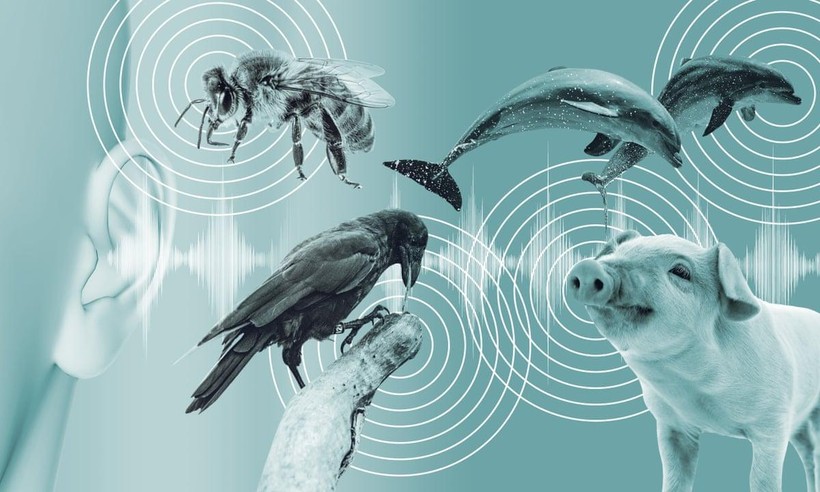
Communication with animals refers to the exchange of information between humans and animals or among animals themselves—using sounds, gestures, body language, facial expressions, chemical signals, vibrations, or other sensory cues.
Have you ever looked into your dog’s eyes and felt as if it understood exactly what you were saying? Or watched dolphins swimming gracefully and wondered whether they were exchanging complex conversations beneath the waves?
For thousands of years, humans have dreamed of communicating with animals. Ancient myths, fairy tales, and modern movies all imagine a world where people and animals share meaningful conversations. While these stories remain fictional, modern science is bringing us closer than ever to understanding how animals communicate—and perhaps one day, how humans might communicate with them.
Researchers across the world are studying everything from whale songs and dolphin whistles to chimpanzee gestures and elephant rumbles. Thanks to artificial intelligence, machine learning, and advanced recording technologies, scientists are decoding animal communication at an unprecedented pace.
But can humans actually have conversations with animals? Or are we simply learning to interpret signals without ever crossing the language barrier?
In this comprehensive guide, we’ll explore the fascinating world of communication with animals, what science currently knows, the challenges researchers face, and what the future may hold.
What Does Communication with Animals Mean?
Unlike human language, most animal communication focuses on immediate needs such as:
- Finding food
- Warning about predators
- Attracting mates
- Defending territory
- Caring for offspring
- Expressing emotions
- Coordinating group behavior
Scientists distinguish between communication and language.
Communication involves sending meaningful signals.
Language, however, includes complex grammar, abstract thinking, storytelling, and the ability to discuss past and future events—abilities currently considered unique to humans.

Why Humans Have Always Wanted to Talk to Animals
The desire for communication with animals is deeply rooted in human history.
Ancient civilizations believed certain animals carried messages from the gods. Indigenous cultures often viewed animals as spiritual teachers capable of sharing wisdom.
Modern society continues this fascination through books and films featuring talking animals.
But beyond fantasy, practical reasons drive scientific interest:
- Improving pet care
- Enhancing livestock welfare
- Conserving endangered species
- Understanding animal intelligence
- Protecting ecosystems
- Reducing human-wildlife conflict
If humans could better understand animals’ needs, countless welfare and conservation efforts could improve dramatically.
How Animals Actually Communicate
Different species have evolved unique communication systems suited to their environments.
Vocal Communication
Many animals rely on sounds.
Examples include:
- Birds singing territorial songs
- Wolves howling to coordinate packs
- Whales producing long-distance calls
- Frogs croaking for mates
- Dolphins using whistles
Each vocalization may carry different meanings depending on pitch, rhythm, duration, and context.
Body Language
Body posture often communicates more than sounds.
Dogs communicate through:
- Tail position
- Ear movement
- Facial expressions
- Eye contact
- Play bows
Cats similarly use body posture to express confidence, fear, curiosity, or aggression.
Many mammals depend heavily on visual signals.
Chemical Communication
Many species “talk” using scent.
Examples include:
- Ant pheromone trails
- Wolf territory markings
- Deer scent glands
- Bee alarm pheromones
Humans possess a relatively weak sense of smell compared with many mammals, making this form of communication difficult for us to interpret.
Touch
Physical contact strengthens social bonds.
Examples include:
- Primates grooming one another
- Elephants touching trunks
- Dolphins rubbing fins
- Dogs licking companions
Touch often conveys trust, affection, reassurance, or social status.
Visual Signals
Some animals communicate through color changes or physical displays.
Examples include:
- Octopus skin patterns
- Cuttlefish color flashes
- Peacock feathers
- Bird courtship dances
These signals may communicate health, reproductive readiness, dominance, or danger.
Dogs: Humanity’s Best Communication Partners
Among all animals, dogs are perhaps the best at communicating with humans.
Thousands of years of domestication have shaped dogs to understand human gestures remarkably well.
Dogs can recognize:
- Pointing
- Facial expressions
- Emotional tone
- Hand signals
- Dozens—and sometimes hundreds—of spoken words
Some exceptionally trained dogs have demonstrated vocabularies exceeding 1,000 object names.
Yet researchers emphasize that recognizing words differs significantly from understanding grammar or complex language.
Dogs excel at interpreting human behavior rather than speaking our language.
Can Chimpanzees Learn Human Language?
Chimpanzees share approximately 98–99% of human DNA.
Because of this close evolutionary relationship, scientists have long explored whether chimps can learn language.
Several famous experiments taught captive chimpanzees:
- American Sign Language
- Lexigram symbols
- Gesture-based communication
These studies showed chimps could learn hundreds of symbols and combine them meaningfully.
However, they did not develop the grammatical complexity characteristic of human language.
Their communication remained relatively simple compared with human conversation.

Dolphins: Masters of Acoustic Communication
Dolphins possess some of the most sophisticated communication systems known.
Researchers have discovered:
- Signature whistles functioning like names
- Individual recognition
- Cooperative hunting signals
- Social learning
- Complex vocal exchanges
Their large brains and highly social lifestyles make dolphins leading candidates for future interspecies communication research.
Scientists continue investigating whether dolphin whistles possess grammar-like organization.
Whales and the Mystery of Ocean Languages
Sperm whales produce rapid clicking sequences known as codas.
These codas appear to vary between families and populations.
Large international research efforts are now attempting to decode these vocal patterns using artificial intelligence.
Researchers hope to determine whether whales communicate:
- Identity
- Family relationships
- Navigation
- Hunting coordination
- Emotional states
- Environmental information
Although much remains unknown, whale communication appears more structured than previously believed.
Birds: Surprisingly Advanced Communicators
Bird communication extends far beyond singing.
Many bird species use:
- Songs
- Alarm calls
- Flight displays
- Feather positions
- Courtship dances
Some parrots demonstrate remarkable vocal learning abilities.
African grey parrots, for example, can associate words with objects, colors, shapes, and numbers, showing impressive cognitive flexibility.
Still, scientists caution against confusing vocal imitation with true language comprehension.
Do Animals Have Language?
This remains one of biology’s biggest questions.
Many researchers agree that animals possess sophisticated communication systems.
However, most scientists argue these systems lack several defining characteristics of human language.
Human language includes:
- Grammar
- Syntax
- Infinite creativity
- Abstract concepts
- Storytelling
- Hypothetical thinking
- Cultural transmission through speech
Animal communication tends to focus on immediate situations rather than abstract ideas.
For now, language appears uniquely human.

Artificial Intelligence Is Transforming Animal Communication Research
Artificial intelligence is revolutionizing communication with animals.
Traditional research relied on human observation.
Today, AI systems can analyze millions of animal sounds far faster than humans.
Machine learning identifies subtle patterns involving:
- Frequency
- Timing
- Pitch
- Duration
- Sequence
- Social context
These technologies reveal structures previously impossible to detect.
Researchers hope AI may eventually function as a translation tool between species.
How Scientists Decode Animal Communication
Understanding animal communication requires combining multiple disciplines.
Researchers use:
Acoustic Recording
Sensitive underwater microphones and forest recording stations capture enormous audio libraries.
Behavioral Observation
Scientists compare sounds with observable behaviors.
For example:
- Feeding
- Hunting
- Social interaction
- Aggression
- Parenting
Context often provides clues about meaning.
Computer Modeling
Deep learning algorithms search for recurring vocal patterns.
The more data collected, the more accurate these models become.
Comparative Biology
Researchers compare communication systems across related species to identify evolutionary patterns.

Why Understanding Animal Communication Is So Difficult
Despite technological advances, major obstacles remain.
Different Sensory Worlds
Animals experience reality differently.
Dogs prioritize smell.
Bats rely on echolocation.
Birds detect ultraviolet light.
Whales communicate underwater across vast distances.
Humans simply do not perceive the world as they do.
Context Changes Meaning
The same sound may carry different meanings depending on:
- Location
- Social group
- Time
- Threat level
- Individual identity
Interpreting these differences is extraordinarily challenging.
Lack of Shared Experience
Even if animals could use human words, their experiences differ dramatically.
A lion’s understanding of “danger” or “family” may not resemble ours.
Communication requires shared context—not merely shared vocabulary.
Benefits of Better Communication with Animals
Improving communication offers numerous real-world applications.
Better Pet Care
Owners could identify:
- Pain
- Anxiety
- Hunger
- Illness
- Emotional needs
Earlier detection means healthier animals.
Wildlife Conservation
Understanding animal communication may help conservationists:
- Monitor endangered populations
- Reduce habitat disturbance
- Prevent conflicts
- Protect migration routes
Animals may even signal environmental changes before humans notice them.
Livestock Welfare
Farm animals communicate stress long before obvious symptoms appear.
Decoding these signals could improve:
- Housing
- Nutrition
- Health care
- Ethical farming practices
Scientific Discovery
Studying communication expands our understanding of:
- Intelligence
- Evolution
- Neuroscience
- Social behavior
- Learning
Every discovery reveals more about life on Earth.
Could Humans Ever Hold Conversations with Animals?
The answer depends on what we mean by “conversation.”
If conversation means:
- Understanding emotions
- Recognizing needs
- Interpreting signals
then humans already communicate with many domestic animals every day.
If conversation means discussing philosophy, memories, politics, or future plans using shared grammar, science remains highly skeptical.
Current evidence suggests animals possess impressive communication systems but not human-like language.
Nevertheless, advances in AI, neuroscience, and behavioral science continue narrowing the gap between understanding and misunderstanding.
Common Myths About Communication with Animals
Myth 1: Animals Speak Secret Human Languages
There is no scientific evidence supporting hidden human-like languages among animals.
Myth 2: Pets Understand Every Word We Say
Animals often recognize tone, routine, gestures, and key words rather than complete sentences.
Myth 3: Telepathic Animal Communication Is Scientifically Proven
Claims of psychic communication remain unsupported by reliable scientific evidence.
Myth 4: AI Will Soon Let Us Chat with Every Animal
AI may decode communication patterns, but genuine conversations remain a long-term scientific challenge.
The Future of Communication with Animals
The coming decades promise exciting breakthroughs.
Researchers expect improvements in:
- AI translation models
- Bioacoustic monitoring
- Wearable animal sensors
- Brain-computer interfaces
- Long-term behavioral databases
Rather than making animals speak human language, these technologies may help humans better understand animals on their own terms.
This shift—from teaching animals our language to learning theirs—could transform biology, conservation, and our relationship with nature.
Frequently Asked Questions
Can humans really communicate with animals?
Yes, humans already communicate with many animals through gestures, voice, training, and behavioral cues. However, this differs from having human-like conversations.
Which animals communicate most like humans?
Dolphins, whales, chimpanzees, bonobos, elephants, parrots, and some corvids possess some of the most sophisticated communication systems known.
Can AI translate animal languages?
AI can identify complex patterns in animal vocalizations, but it has not yet translated animal communication into human language with proven accuracy.
Why are dogs so good at understanding people?
Thousands of years of domestication have selected dogs that excel at interpreting human facial expressions, gestures, tone of voice, and social behavior.
Will humans ever talk to animals?
Scientists remain divided. While improved understanding is likely, fully human-like conversations remain speculative and may never be possible.
Conclusion
The dream of communication with animals has fascinated humanity for centuries. While science has not uncovered evidence that animals possess language comparable to our own, research continues to reveal extraordinary complexity in the ways animals exchange information.
Dogs read our emotions with remarkable accuracy. Dolphins recognize one another through signature whistles. Whales produce intricate vocal patterns that may carry rich social meaning. Primates use gestures, facial expressions, and learned symbols to communicate effectively. Across forests, oceans, deserts, and skies, countless species have evolved communication systems perfectly suited to their unique environments.
Artificial intelligence is opening exciting new possibilities, helping researchers uncover patterns once hidden within millions of animal sounds and behaviors. Rather than teaching animals to speak like humans, the future may lie in learning to understand them on their own terms.
Whether or not humans ever achieve true conversations with animals, one lesson is already clear: every species has its own voice. By listening more carefully, respecting their natural ways of communicating, and continuing scientific exploration, we deepen our appreciation of the remarkable diversity of life on Earth—and strengthen our responsibility to protect it.
Sources
- National Geographic – Will Humans and Animals Ever Be Able to Converse? Here’s What Science Says
- Project CETI (Cetacean Translation Initiative)
- University of Cambridge – Animal Communication Research
- Tel Aviv University – Zoology and Bioacoustics Research
- Smithsonian Magazine – Animal Intelligence
- Nature Reviews Neuroscience
- Current Biology
- Journal of Comparative Psychology
- Animal Behaviour