Most interesting animals of the world are not only fascinating because of their appearance but also because of their incredible stories. Some have survived for thousands of years, some have developed extraordinary physical abilities, and some have overcome the challenges of habitat loss and population decline.
Our planet is home to millions of animal species, each with unique abilities, behaviors, and survival strategies. From the deepest oceans to the driest deserts and the thickest rainforests, animals have evolved in remarkable ways to adapt to their environments. Some creatures are powerful predators, some are gentle giants, and others possess strange characteristics that make them seem almost mythical.
Exploring these animals allows us to understand the complexity of nature. Every species has a role in its ecosystem, whether it is a predator maintaining balance, a herbivore shaping landscapes, or a scavenger helping recycle nutrients.
In this article, we will discover some of Earth’s most interesting animals, including the southern white rhinoceros, Sumatran tiger, desert tortoise, platypus, Przewalski’s horse, California condor, Père David’s deer, and the mysterious okapi.
What Makes an Animal Interesting?
An animal becomes truly fascinating when it displays unusual traits, remarkable adaptations, or behaviors that challenge our expectations.
Some animals survive in extreme environments by developing special skills. Desert creatures may store water or avoid heat, while rainforest animals often rely on camouflage and specialized body structures.
Other animals are interesting because of their evolutionary history. Certain species have ancient origins and represent connections to the past. They show how life has changed over millions of years.
Many of the world’s most interesting animals also teach us important lessons about conservation. Some have faced extinction but survived because humans worked to protect them.

Southern White Rhinoceros: The Powerful Giant of the Grasslands
The southern white rhinoceros is one of the largest land animals on Earth. Although its name suggests a pale color, these rhinos are actually gray. The word “white” is believed to come from an Afrikaans term describing their wide, square-shaped mouths.
These impressive animals are mainly found in southern Africa. They are grazers, meaning they spend much of their time eating grasses across open landscapes.
Unlike some rhino species that prefer a solitary lifestyle, southern white rhinos are often semi-social. Females and young rhinos may live together in groups, while adult males usually establish territories.
One of the most interesting behaviors of the white rhino is its relationship with mud. Rhinos frequently roll in muddy water to cool their bodies, protect their skin from insects, and create a natural layer of defense against the harsh environment.
Despite their size and strength, southern white rhinos face conservation challenges. Protecting their habitats and preventing illegal hunting remain important steps in ensuring their survival.
Sumatran Tiger: The Silent Predator of the Forest
The Sumatran tiger is one of the most fascinating big cats in the world. Native to the island of Sumatra in Indonesia, it is the smallest living tiger subspecies.
Its smaller size is believed to be an adaptation to life in dense island forests. Unlike large predators that rely on long-distance pursuit, the Sumatran tiger is a master of stealth.
This tiger uses patience and careful movement to approach prey before launching a sudden attack. Its hunting strategy depends on surprise rather than endurance.
The Sumatran tiger can reach impressive speeds during short bursts, but its greatest weapon is its ability to disappear into the forest.
Unfortunately, the Sumatran tiger is critically endangered. Habitat destruction and human conflict have greatly reduced its population. Conservation programs are essential to protect this beautiful predator and preserve the biodiversity of Indonesia’s forests.
Desert Tortoise: A Survivor of Extreme Heat
The desert tortoise is a true example of adaptation. Living in some of the hottest regions of North America, this reptile has developed incredible methods for surviving harsh desert conditions.
During extreme heat, desert tortoises escape underground by digging burrows that can extend many feet into the earth. These shelters provide protection from high temperatures and allow them to conserve energy.
One of the most remarkable abilities of the desert tortoise is water storage. It can collect and store water inside its body, allowing it to survive long periods without drinking.
The desert tortoise is usually peaceful and solitary, but males sometimes compete for dominance. They may use the curved structures beneath their shells to push and flip rivals during battles.
This slow-moving animal demonstrates that survival does not always depend on speed or strength. Sometimes patience and adaptation are the greatest advantages.

Platypus: Nature’s Unusual Combination
Few animals are as strange and fascinating as the platypus. Native to Australia, this creature looks like a combination of several different animals, with a duck-like bill, beaver-like tail, and otter-like body.
The platypus is one of only a small number of mammals that lay eggs. After hatching, young platypuses are cared for by their mothers inside underground burrows.
The platypus is also an incredible hunter. When searching for food underwater, it closes its eyes, ears, and nostrils. Instead, it relies on its highly sensitive bill to detect movements from small aquatic creatures.
Although it looks harmless, male platypuses have venomous spurs on their hind legs. This unusual defense mechanism makes the platypus one of the most unique mammals on Earth.
The existence of the platypus reminds us that evolution can create forms of life that seem impossible.
Przewalski’s Horse: The Last Truly Wild Horse?
The Przewalski’s horse is one of the most remarkable horses in the world. Unlike modern domestic horses, these animals have lived independently in the wild for generations.
Named after explorer Nikolai Przewalski, these horses once roamed across large areas of Asia and Europe. However, during the twentieth century, their wild populations disappeared.
Through captive breeding programs and conservation efforts, Przewalski’s horses have been successfully reintroduced into protected areas.
These horses live in social groups. A dominant stallion usually leads a family group, while younger males may form separate bachelor groups.
Their survival story is one of conservation success. Although their population remains limited, the return of Przewalski’s horses demonstrates how dedicated protection efforts can help endangered species recover.
California Condor: The Giant Bird of the Sky
The California condor is one of the most impressive flying birds in North America. With a wingspan reaching nearly ten feet, this bird can glide through the sky with incredible efficiency.
Unlike many birds of prey, condors are scavengers. They feed on the remains of large animals and play an important ecological role by helping clean up natural environments.
California condors are capable of flying at extremely high altitudes and can travel hundreds of miles while searching for food.
However, these birds faced a severe population crisis. Slow reproduction rates and environmental threats pushed them close to extinction.
Conservation breeding programs helped increase their numbers, giving this magnificent bird another chance to survive.
The California condor represents the importance of protecting even the most vulnerable species.

Père David’s Deer: The Deer That Returned From Extinction
Père David’s deer is one of the most unusual deer species in existence. Originally from China, this large deer developed adaptations that allow it to live in wet environments.
Its webbed hooves make it an excellent swimmer, and it often feeds on aquatic plants and grasses.
Unlike typical deer antlers, Père David’s deer have a unique structure where the front branch can be larger than the rear branch.
The history of this species is remarkable. After disappearing from the wild, the remaining animals survived in a protected imperial area. Later, breeding programs in Europe helped preserve the species.
Eventually, Père David’s deer were returned to China, showing how conservation can bring animals back from the edge of extinction.
Okapi: The Hidden Relative of the Giraffe
The okapi is one of the most mysterious animals in the world. Found only in the forests of the Democratic Republic of Congo, this shy creature was unknown to many people until modern times.
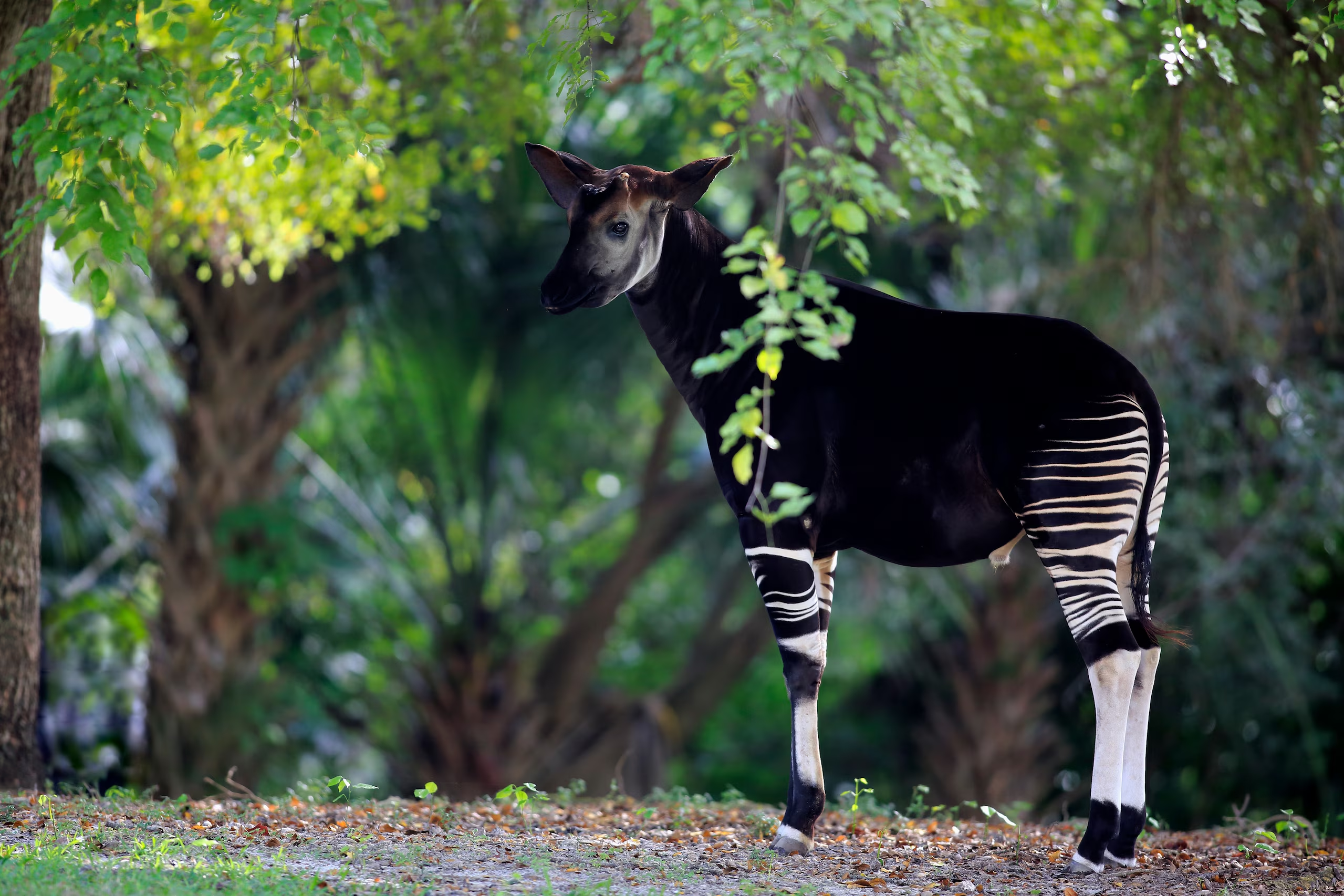
At first glance, the okapi looks like a mixture of a zebra and a deer because of its striped legs and body shape. However, it is actually the closest living relative of the giraffe.
The okapi’s stripes help it blend into the forest environment, where sunlight creates patterns through the trees.
Another amazing feature is its long, flexible tongue. Similar to a giraffe’s tongue, it allows the okapi to reach and remove leaves from branches.
The okapi’s specialized digestive system helps it process a diet of leaves, fruits, and vegetation.
Because it lives in dense rainforest habitats, the okapi remains difficult to study, making it one of nature’s most mysterious treasures.
Protecting Earth’s Amazing Animals
The most interesting animals on Earth are valuable not only because they are beautiful or unusual but because they are part of complex ecosystems.
Many of these species face threats caused by habitat destruction, climate change, and human activity. Protecting wildlife means protecting the environments that support all forms of life.
Conservation efforts, scientific research, and public awareness can help ensure that future generations continue to experience the wonder of these incredible creatures.
Every animal has a story. Some stories are about survival, some about adaptation, and others about recovery after facing extinction.

Conclusion: Nature’s Endless Collection of Wonders
The animal kingdom is filled with extraordinary creatures that continue to amaze us. The southern white rhinoceros, Sumatran tiger, desert tortoise, platypus, Przewalski’s horse, California condor, Père David’s deer, and okapi each reveal a different side of nature’s creativity.
Their unique abilities and survival strategies show that life can adapt in countless ways.
By learning about these animals, we gain a deeper appreciation for biodiversity and the importance of protecting our planet. The more we explore nature, the more we discover that Earth is full of fascinating animals waiting to be understood.
Sources
National Geographic. “Earth’s Most Interesting Animals.”
Wildlife conservation organizations and scientific research resources.