Mysterious animals have inspired legends, stories, and even fantasy characters because their real-life traits appear magical. Some can regenerate parts of their bodies, others have evolved incredible camouflage skills, and some look like creatures from another world.
The truth is that nature does not need imagination to create wonders. Evolution itself has produced animals with remarkable adaptations that help them survive in challenging environments.
In this article, we will explore 5 magical and mysterious animals you should know about. These fascinating creatures include the amazing Axolotl, the armored Pangolin, the unusual Tufted Deer, the enchanting Leafy Sea Dragon, and the adorable Sunda Colugo.
Each of these animals has a special story to tell, showing us how diverse and creative life on Earth can be.
1. The Amazing Axolotl: The Creature That Never Grows Up
Deep beneath the waters of Lake Xochimilco near Mexico City lives one of the most fascinating amphibians on Earth: the Axolotl.
Often described as a creature that looks like it belongs in a fantasy world, the Axolotl has captured the attention of scientists, animal lovers, and even popular culture fans. With its cute appearance, tiny smiling face, and unusual external gills, this animal looks almost like a character from a magical story.
However, the real science behind the Axolotl is even more impressive.

A Unique Amphibian With a Permanent Youthful Appearance
Most amphibians, such as frogs and salamanders, begin life in water and later transform into adults that live partly on land. The Axolotl is different.
This animal experiences a rare biological phenomenon called neoteny. Instead of completely transforming into a land-based adult, the Axolotl keeps many juvenile features throughout its life.
This means it maintains its aquatic lifestyle, external gills, and youthful appearance even after reaching maturity.
Imagine an animal that grows older but still keeps the features of its younger form. That is what makes the Axolotl truly mysterious.
The Amazing Regeneration Ability
One of the most remarkable abilities of the Axolotl is its natural talent for regeneration.
Unlike many animals, Axolotls can regrow certain body parts, including limbs and other tissues. Scientists have studied these creatures for years to better understand how regeneration works.
Their ability comes from complex biological processes that allow their bodies to repair damaged areas in unique ways.
This incredible feature has made the Axolotl an important subject in scientific research.
A Symbol of Mexican Culture and Nature
The Axolotl is not only a biological wonder but also an important animal in Mexican history and culture. The creature has connections to ancient stories and traditions, making it a symbol of the relationship between humans and nature.
Unfortunately, wild Axolotl populations face challenges due to habitat changes and environmental pressures. Conservation efforts are important to protect this extraordinary species for future generations.
The Axolotl reminds us that some of the most magical creatures are not found in myths but in the natural world around us.
2. The Armored Pangolin: The Walking Creature With Natural Protection
Mysterious animals, when people imagine them, the Pangolin is one of the first creatures that comes to mind.
With its overlapping scales, long body, and unusual appearance, the Pangolin looks like a combination of several different animals. Some people compare it to a living piece of ancient armor.
But this fascinating mammal is completely real.
The Only Mammal Covered in Protective Scales
The Pangolin is unique because it is the only known mammal covered with scales.
These scales are made of keratin, the same natural material found in human fingernails and hair. This creates a strong protective layer that helps the Pangolin defend itself.
When threatened, a Pangolin can curl into a tight ball, using its scales as a shield.
This defense strategy is one of the most interesting examples of adaptation in the animal kingdom.
A Nighttime Explorer
Pangolins are mostly nocturnal, meaning they are active during the night.
After sunset, they search for their favorite food: ants and termites. Their long claws help them open insect nests, while their long sticky tongues allow them to collect food efficiently.
Their feeding style is similar to some insect-eating animals, but their armored body makes them completely different.

A Quiet Forest Guardian
Pangolins live in parts of Asia and Africa, often making homes in hollow trees or underground burrows.
Despite their unusual appearance, they are gentle and mostly peaceful animals. They play an important role in ecosystems by controlling insect populations.
Their mysterious appearance and secretive lifestyle have made them one of nature’s most fascinating creatures.
3. The Majestic Tufted Deer: The Tiny Deer With a Surprising Feature
Mysterious animals, when most people think about deer, they imagine graceful animals with elegant antlers.
The Tufted Deer challenges that image.
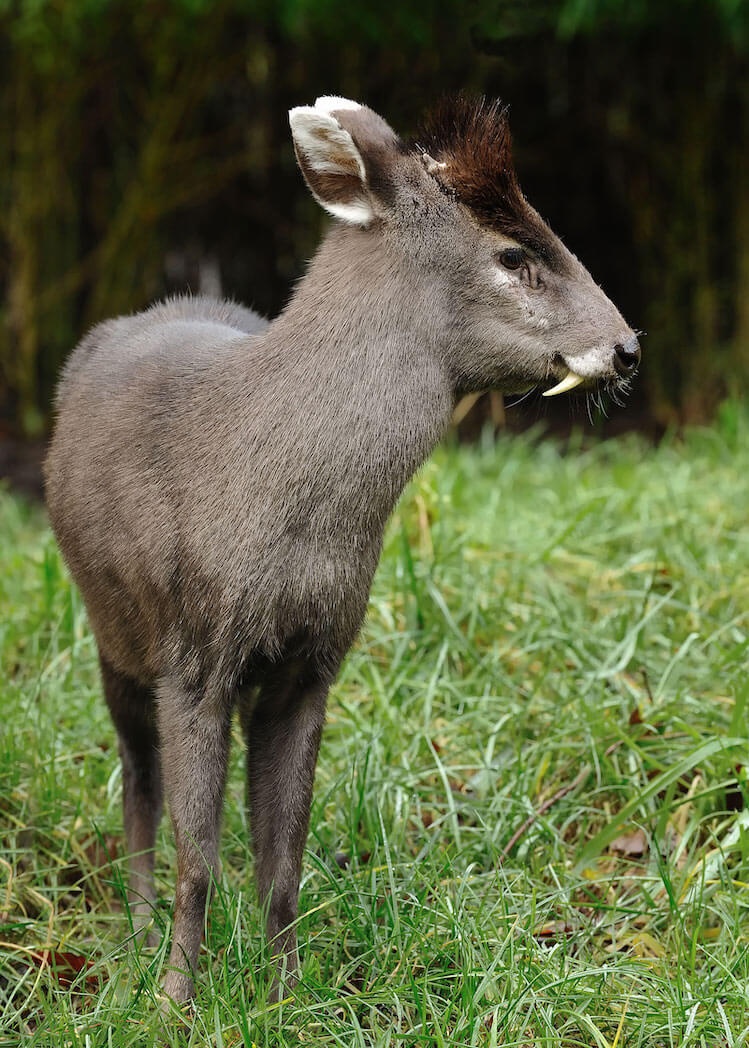
Found mainly in China, this small deer species looks like something from an ancient forest legend. Its unusual appearance makes it one of the most mysterious animals in the world.
A Deer Unlike Any Other
The Tufted Deer belongs to a unique group of deer species. Instead of large antlers like many other deer, males have long canine teeth that extend outward like small tusks.
These sharp teeth give them a surprisingly different appearance.
Although they may look unusual, these teeth are a natural adaptation and part of their normal biology.
The Mysterious Hair Tuft
Another fascinating feature of the Tufted Deer is the dark tuft of hair on its forehead.
This hair can grow several inches long, creating a distinctive look. Combined with its small size and unusual teeth, the Tufted Deer appears almost like a creature from folklore.
A Quiet Life in the Forest
Tufted Deer are generally shy and often live alone or in pairs.
They are most active during dawn and dusk, times when the forest is quieter and many predators are less active.
Their ability to remain hidden among vegetation helps them survive in their natural environment.
The Tufted Deer shows that even familiar animal groups can contain surprising mysteries.

4. The Strange Leafy Sea Dragon: The Ocean’s Living Plant
The ocean is home to some of Earth’s most creative designs, and few creatures demonstrate this better than the Leafy Sea Dragon.
Native to Australia, this marine animal looks like a piece of floating seaweed.
But beneath its plant-like appearance is a fascinating fish with incredible adaptations.
Nature’s Master of Camouflage
The Leafy Sea Dragon has leaf-shaped extensions covering its body.
These structures are not plants but specialized body parts that help it blend into underwater environments.
By moving slowly through the water, it can appear almost invisible among seaweed and marine plants.
This camouflage protects it from threats and helps it approach tiny prey.
A Slow and Beautiful Swimmer
Unlike many fast-moving ocean animals, the Leafy Sea Dragon moves slowly.
Its transparent fins gently wave as it travels through the water, creating a floating appearance.
This graceful movement is one reason why many people consider it one of the most beautiful marine creatures.

A Special Ocean Treasure
The Leafy Sea Dragon has become an important symbol of marine conservation.
Its existence reminds us that underwater ecosystems contain countless animals that remain unknown to many people.
Protecting ocean habitats helps preserve these living examples of nature’s creativity.
5. The Adorable Sunda Colugo: The Animal That Flies Without Flying
The Sunda Colugo, also known as the Sunda Flying Lemur, is another animal that seems almost impossible.
Despite its nickname, the Colugo is not actually a lemur and does not truly fly.
Instead, it is an expert glider.
The Ultimate Tree Traveler
Colugos live high in the trees of Southeast Asia.
They have a special membrane of skin that stretches between their legs and body. This membrane works like a natural parachute, allowing them to glide from tree to tree.
This ability helps them move efficiently through forests without needing to climb down to the ground.
A Nocturnal Forest Creature
Sunda Colugos are mainly active at night.
They feed on leaves, flowers, and fruits while moving quietly through the forest canopy.
Their large eyes help them navigate in low-light conditions.
A Hidden Life Above the Ground
Because they spend most of their lives in trees, many people rarely see Colugos in the wild.
Their secretive lifestyle and unusual appearance make them one of the most mysterious mammals in Southeast Asia.
Why These Animals Feel Magical
The five animals in this list are not magical because they have supernatural powers.
They are magical because they reveal the incredible creativity of evolution.
The Axolotl shows the mystery of regeneration. The Pangolin demonstrates natural protection. The Tufted Deer proves that familiar animals can still surprise us. The Leafy Sea Dragon shows the power of camouflage. The Sunda Colugo reveals how animals adapt to their environment.
Every species has developed unique traits that help it survive.
The more we learn about animals, the more we understand that reality is often more fascinating than imagination.
Conclusion: Nature’s Greatest Mysteries Are Still Waiting
The world is full of incredible creatures that remind us how amazing life on Earth truly is.
From the waters of Mexico to the forests of Asia and the oceans of Australia, these animals represent the endless variety of nature.
The 5 magical and mysterious animals you should know about are more than just unusual creatures. They are examples of adaptation, survival, and the beautiful connection between living things and their environments.
By learning about these animals, we can develop greater appreciation and respect for wildlife.
Nature continues to surprise us every day, and perhaps the next great mystery is already waiting somewhere in the wild.
Sources
National Geographic – Animal Facts and Wildlife Education
Smithsonian’s National Zoo & Conservation Biology Institute – Species Information
World Wildlife Fund – Wildlife Conservation Resources
International Union for Conservation of Nature (IUCN) – Red List of Threatened Species
Encyclopedia Britannica – Animal Biology References