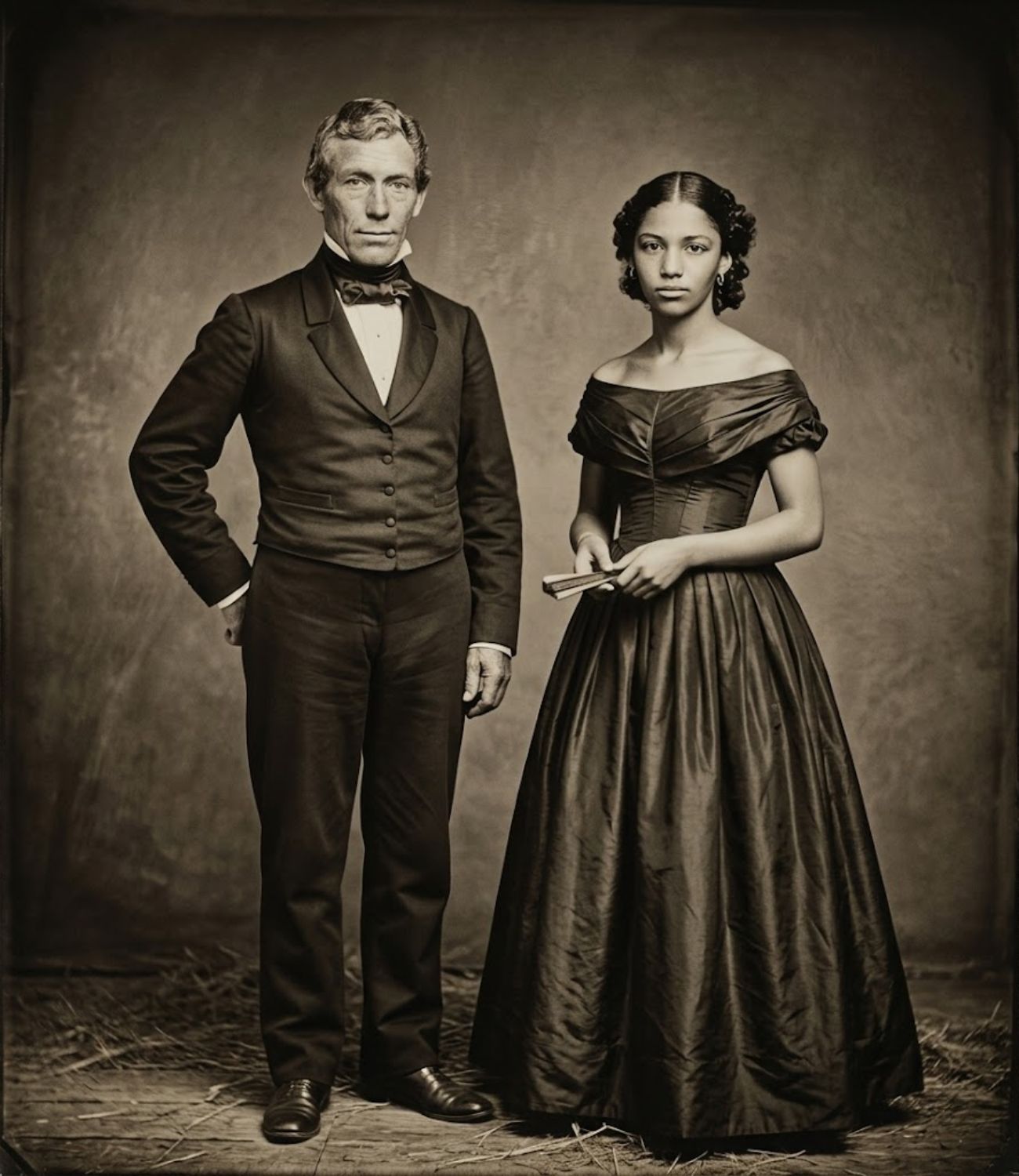
The story of Thomas Jefferson and Sally Hemings is a complex narrative of power, promise, and the profound contradictions inherent in the early days of the United States. It is a story of a man who authored the words “all men are created equal” while living a private life that deeply entangled him with the institution of slavery.
The Inheritance of a Promise
Thomas Jefferson’s wife, Martha Wayles Jefferson, passed away in 1782. On her deathbed, it is said Jefferson promised he would never remarry—a vow he kept. However, the void left by Martha’s death was soon filled by a presence from her own family’s past. Martha had brought to her marriage a significant dowry that included land and several dozen enslaved people. Among them was the Hemings family.
Elizabeth Hemings, the matriarch, had been the slave of Martha’s father, John Wayles. It is a documented historical reality that John Wayles was the father of six of Elizabeth’s children, making them Martha Jefferson’s half-siblings. One of these children was Sally Hemings.
Sally was only nine years old when she arrived at Monticello. She did not look like the other enslaved children; she had fair skin and long, straight hair, reflecting her mixed ancestry. Because of her connection to the Wayles family, Sally and her siblings were granted privileges that the other hundreds of enslaved people on the plantation were denied. Sally was never sent to the fields; instead, she was assigned to the main house, where she worked in close proximity to Jefferson and his daughters.

Paris: The Turning Point
In 1784, Jefferson was sent to Paris as the American Minister to France. He initially took only his eldest daughter, Patsy. Three years later, he sent for his nine-year-old daughter, Polly. Due to a last-minute illness of an adult companion, the fourteen-year-old Sally Hemings was chosen to accompany the child across the Atlantic.
When Sally arrived in Paris in 1787, she was no longer a child. She was described as a striking young woman who bore a strong resemblance to her half-sister, Jefferson’s deceased wife. In Paris, the legal landscape was entirely different from Virginia. On French soil, slavery was not recognized. Sally was technically free; she could have sued for her manumission or sought asylum.
During these two years in Paris, Jefferson paid for Sally to receive training in French, fine needlework, and etiquette. It was during this period, when she was approximately sixteen and he was forty-four, that their physical relationship began.
When the time came for Jefferson to return to America in 1789 to serve as George Washington’s Secretary of State, Sally initially refused to go. She was pregnant and realized that returning to Virginia meant returning to a life of bondage for herself and her unborn child. To persuade her, Jefferson made a monumental promise: if she returned to Monticello, he would ensure that all her children would be granted their freedom upon turning twenty-one. Sally, young and alone in a foreign land, accepted the bargain.
Life in the Shadow of Monticello
Upon returning to Virginia, Sally was settled into a small room in the South Wing of Monticello, located directly adjacent to Jefferson’s own suite. This proximity was unheard of for an enslaved person. Between 1790 and 1808, Sally gave birth to six children.
The domestic life at Monticello during these years was a study in silence. While Jefferson lived as the “Sage of Monticello” and eventually as the President of the United States, Sally’s children—Beverly, Harriet, Madison, and Eston—grew up in the house. They were taught to read and write and were trained in skilled trades like carpentry and music. Visitors to the plantation often remarked on the presence of “light-skinned” children who bore an uncanny resemblance to the President, yet the topic remained a forbidden one in polite society.
The Scandal of 1802
The wall of silence was shattered in September 1802. James Callender, a disgruntled journalist who had once been a political ally of Jefferson, published a scathing exposé in the Richmond Recorder. He alleged that President Jefferson kept an enslaved “concubine” named Sally and had fathered several children with her.
The scandal ignited a political firestorm. Jefferson’s opponents, the Federalists, used the story to paint him as a moral hypocrite. Satirical poems and cartoons circulated throughout the young nation. Yet, throughout the entire ordeal, Jefferson never issued a single public denial or confirmation. He remained silent, relying on the shield of his power and the defense of his white family, who claimed the children were fathered by Jefferson’s nephews, the Carr brothers.
The Legacy of the Hemings Children
Jefferson died on July 4, 1826, the fiftieth anniversary of the Declaration of Independence. In his will, he freed five enslaved men—all members of the Hemings family. This included Sally’s sons, Madison and Eston. He had already allowed Beverly and Harriet to “walk away” from the plantation years earlier, even providing Harriet with funds to travel.
Crucially, Jefferson did not free Sally. She remained legally enslaved at the time of his death. It was only after his passing that Jefferson’s daughter, Martha, allowed Sally to leave Monticello and live “informally” as a free woman with her sons in Charlottesville until her death in 1835.
The children of Sally Hemings took divergent paths to navigate the racial boundaries of the 19th century:
-
Beverly and Harriet: Both moved north, married white partners, and entered white society. They effectively erased their pasts to protect themselves and their children from the stigma of their ancestry.
-
Eston: He initially lived as a person of color in Ohio but eventually moved further west, changed his name to Eston Hemings Jefferson, and lived as a white man. His descendants were aware of their connection to Jefferson but kept it private for generations.
-
Madison: He was the only child who lived his life as a black man. In 1873, he gave a groundbreaking interview to an Ohio newspaper, detailing his parentage and the life he lived at Monticello. For over a century, his testimony was dismissed by historians as an attempt to gain fame.
Science and the Restoration of Truth
For nearly two hundred years, the relationship between Thomas Jefferson and Sally Hemings was treated as a myth or a malicious rumor by the majority of the American public and the academic community. The Jefferson family descendants and many biographers vigorously defended the “nephew theory,” arguing that a man of Jefferson’s intellectual and moral stature could not have engaged in such a relationship.
However, in 1998, the narrative changed forever. A DNA study compared the Y-chromosome of descendants of the Jefferson male line with descendants of Eston Hemings. The results showed a perfect match. Given that Thomas Jefferson was the only Jefferson male present at Monticello during the times Sally’s children were conceived, the scientific conclusion was undeniable.
Science finally corroborated the oral history of the Hemings family and the 1873 testimony of Madison Hemings. Today, the Thomas Jefferson Foundation officially recognizes the relationship. At Monticello, Sally Hemings is no longer an invisible figure in the background; her life and her room are now part of the educational experience of the museum.
The story of Sally Hemings is a poignant reminder of the “shadow families” that existed across the American South—lives lived in the margins of history, shaped by the immense power of those who owned them and the quiet resilience of those who survived.
The revelation of Jefferson’s relationship with Sally Hemings has deeply complicated his legacy as a Founding Father. Do you think it’s possible to fully separate a person’s historic intellectual contributions from their private moral choices, or must they be viewed as one inseparable whole?