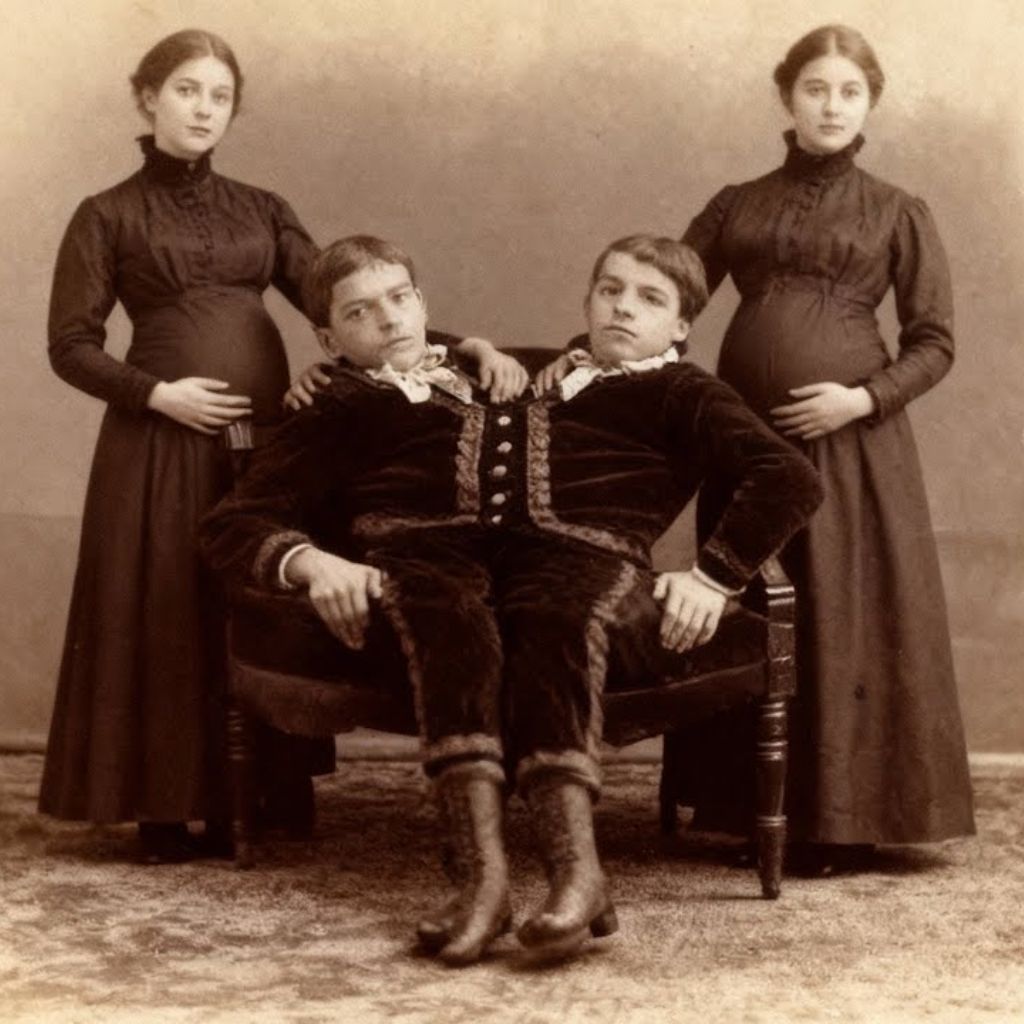
The saga of Chang and Eng Bunker, the original “Siamese Twins,” remains one of the most complex chapters in 19th-century American history. While their public lives as traveling curiosities are well-documented, their private transition into the role of North Carolina gentleman planters—and the subsequent creation of a massive, interconnected family—offers a profound look at the human drive for domesticity against impossible odds. In 1843, when these two brothers married sisters Adelaide and Sarah Yates, they didn’t just merge two families; they created a unique social ecosystem that challenged the era’s legal, religious, and biological definitions of “normalcy.“
This article explores the cultural impact of the Bunker family, the psychological complexities of their “rotating” household, and the scientific realities of a life bound by a four-inch band of flesh.
The Blue Ridge Transition: From Spectacle to Citizen
By the time Chang and Eng settled in Surry County, North Carolina, they were international celebrities who had spent decades under the global microscope. Their decision to settle in a rural, conservative community was an act of profound social ambition. They sought to transcend their status as “objects” and become “subjects”—landowners, farmers, and heads of households.
Their adoption of the surname “Bunker” was a symbolic shedding of their past. However, the local community’s acceptance was contingent on the twins’ ability to adhere to Southern social hierarchies. By becoming successful tobacco planters and slaveholders, they aligned themselves with the local elite. Yet, the 1843 double wedding to the Yates sisters pushed this acceptance to its limit, forcing a rigid society to confront a domestic arrangement for which there was no precedent in Western law or tradition.
Cultural Significance: The Myth of the “Monstrous” vs. the Reality of Love
In the cultural imagination of the 1800s, conjoined twins were often framed through the lens of mythology or “natural warnings.” The Bunkers spent their lives refuting these labels. Their marriage to Adelaide and Sarah was, in many ways, an attempt to claim the ultimate badge of 19th-century manhood: the role of husband and father.
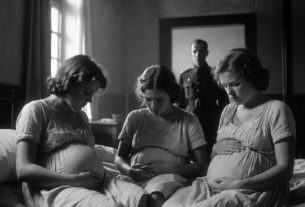
The cultural scandal surrounding their 21 children—10 fathered by Chang and 11 by Eng—stemmed from a communal inability to conceptualize individual agency within a shared physical existence. Neighbors struggled to reconcile the Christian “one flesh” theology of marriage with the literal one-flesh reality of the brothers. This led to a bifurcated reputation: in their presence, they were respected neighbors; in whispers, they were a source of profound moral anxiety. The “Invisible Wall” described by Sheriff Gilmer was not just between the two houses they built, but between the brothers’ private dignity and the public’s voyeuristic judgment.

Scientific Perspectives: The Physiology of Connection
From a medical standpoint, the Bunker twins were omphalopagus conjoined twins, joined at the lower chest. During their lives, numerous physicians speculated on the nature of their connection. The prevailing 19th-century medical opinion was that any attempt at surgical separation would be fatal, as it was believed they might share vital organs or a singular circulatory system.
Modern scientific retrospection, bolstered by the 1874 autopsy conducted in Philadelphia, provides a clearer picture. The brothers were connected by a band of cartilage and a bridge of liver tissue. While the technology of 1843 would have made surgery extremely high-risk, 21st-century medicine suggests that they were prime candidates for a successful separation. The tragedy of their lives lies in the “what if”—the possibility that they could have lived separate lives had they been born in an era of advanced imaging and antiseptic surgery.
The “death from fright” attributed to Eng following Chang’s passing in 1874 is now scientifically framed as a probable result of the shared circulatory system. When Chang’s heart stopped, the metabolic toxins and the shift in blood volume likely overwhelmed Eng’s system, illustrating that while they were two distinct minds, they were biologically interdependent.
The Rotating Household: A Psychological Experiment
The logistics of the Bunker family required a level of discipline and compromise that is almost unfathomable. The “three-day rule”—where the brothers spent three days at Chang’s house with Adelaide and then three days at Eng’s house with Sarah—was a self-imposed social contract designed to mitigate the intense jealousy between the sisters.
Psychologists today might look at this as an extreme form of situational stress. The wives were trapped in a permanent state of “sharing” that violated every contemporary norm of marital privacy. The reports of “haunted” children and “mournful hymns” suggest a household where emotional tension was the primary atmosphere. For the 21 children, the two houses represented two different worlds, yet they were anchored by the same two men who could never be apart, creating a complex web of loyalty and identity.
The Trial of Public Opinion: The 1867 Meeting
The meeting at White Plains Baptist Church in 1867 serves as a pivotal historical moment where the community attempted to “litigate” the Bunkers’ existence. Without a specific crime to charge them with, the neighbors resorted to “moral nuisance” arguments. The defense offered by Chang and Eng—demanding the right to be “ordinary men”—was a radical assertion of human rights for the disabled and the “different.“
This event highlighted the tension between “Natural Law” (as interpreted by the church) and “Individual Liberty” (as sought by the Bunkers). The fact that the meeting ended in exhaustion rather than violence suggests that even in a prejudiced society, the brothers’ personal dignity and economic contributions provided a shield against the most extreme forms of persecution.
Legacy: A Bloodline of 1,500 Souls
The survival and flourishing of the Bunker bloodline is perhaps the most remarkable part of their story. Rather than fading into history as a “bizarre” footnote, the 21 children became the foundation of a massive American family. Today, the descendants of Chang and Eng include doctors, soldiers, and professionals who represent the successful assimilation the twins so desperately wanted.
The Bunker family reunions, held in the shadows of the Blue Ridge Mountains, are a living testament to the endurance of family bonds. They reflect a transition from a legacy of “whispered horror” to one of genealogical pride, showing how time can transform a social scandal into a celebrated heritage.
Reflection: The Persistent Flame of Human Curiosity
The enduring fascination with Chang and Eng Bunker speaks to a fundamental aspect of human curiosity: our desire to understand the limits of the human condition. We are drawn to their story not because it is “monstrous,” but because it is a mirror. It asks us to consider the lengths we would go to for companionship, the sacrifices we would make for our children, and the resilience required to live in a world that refuses to see our true selves.
History often categorizes people by their most visible traits, yet the Bunkers remind us that beneath the physical “wonder” was a deeply relatable struggle for home, land, and love. Their story concludes not with the tragedy of their death, but with the reflection on human curiosity—a force that initially sought to exploit them, but eventually came to recognize the profound humanity in their struggle.
Sources and References
-
National Museum of Health and Medicine: Documentation regarding the 1874 autopsy of Chang and Eng Bunker.
-
The University of North Carolina Press: The Two: The Story of the Siamese Twins by Irving Wallace and Amy Wallace.
-
Journal of the American Medical Association (JAMA): Historical reviews of conjoined twin separations and physiological interdependencies.
-
North Carolina State Archives: Land deeds, census records, and community meeting minutes for Surry County (1840-1880).
-
Smithsonian Magazine: “The Hidden History of the Siamese Twins’ North Carolina Family.”
-
The Bunker Family Association: Genealogical records and oral histories of the descendants of Chang and Eng.