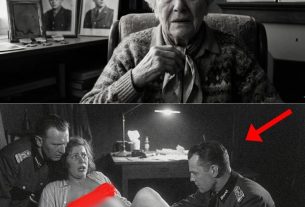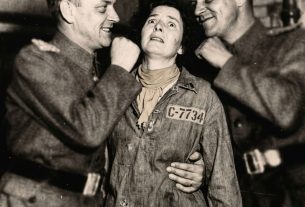
The history of conflict is often written in the bold strokes of territory gained and battles won. We map the movements of divisions and the fall of cities, but there is a parallel history—an invisible one—etched into the lives of those who occupied the spaces between the front lines. My name is Bernadette Martin, and for sixty years, I lived in a prison where the bars were invisible and the walls were made of silence.
In the spring of 1943, in the city of Lyon, the world narrowed down to the corridors of the Grand Étoile Hotel. It was a place where the soul was systematically dismantled, leaving a shell that pretended to be alive on the outside while dying incrementally on the inside.
The Architecture of Contradiction
To walk into the Grand Étoile was to enter a theater of the absurd. My room on the third floor was at the end of a long, dimly lit corridor. Behind a dark wooden door marked with a gold number lay a space designed to mimic the comforts of high society. There were white sheets changed with industrial regularity, a crystal bedside lamp that cast a soft, warm glow, and wallpaper decorated with delicate, hand-painted flowers.
There was even a landscape painting of the French countryside on the wall—a vision of rolling green hills and peace that mocked the reality of the room. This was the Reich’s peculiar obsession: the belief that aesthetic beauty could sanitize a profound violation. It was as if they believed that by providing a clean bed and a pretty view, they could transform a tragedy into a transaction.
The manager of this establishment was Madame Colette. Her presence was perhaps the most painful aspect of the ordeal. She was not a foreign invader; she was French. She was one of our own, yet she managed the abuse of her countrywomen with the mechanical detachment of a factory foreman. She spoke in a voice devoid of inflection, reciting rules about hygiene and “efficiency” as if reading from a ledger. She made it clear that the officers—men like Klaus Richter—expected a service, and it was our duty to provide it without “drama.”
The Ritual of the Automaton
Klaus Richter was the man assigned to me. In the distorted logic of Madame Colette, I was “fortunate.” Richter was an educated man, a professor in civilian life, who wore thin-framed glasses and an impeccable uniform. He did not resort to physical strikes. He did not shout.
Every Tuesday and Friday, precisely at 9:00 p.m., he would arrive. The Germans, I learned, had a religious devotion to punctuality. He would hang his coat on the rack, place his glasses on the bedside table, and address me by my name, pronouncing each syllable with linguistic precision. He treated me like a newly acquired antique—something to be evaluated for its “serviceability.”
In those moments, I discovered the only defense available to the powerless: dissociation.
It is a phenomenon that only those who have faced the unthinkable can truly grasp. You do not leave your body, but you disconnect from it. You retreat into a mental basement, a hidden cellar of the mind where the violation cannot fully reach. You become an “envelope.” You let the physical shell do what is required while the real “you” flees to a place of inner silence.
Richter would sometimes talk about his children and his wife in Bavaria, who wrote to him weekly. He spoke of the war as a righteous endeavor. To him, I was a “tool”—a necessary resource for a tired soldier. This bureaucratic, ritualized treatment was more devastating than an outburst of rage because it was so utterly normalized. It was the “banality of evil” distilled into a twice-weekly appointment.

The Industrial Logic of the Reich
We were not the only ones in the hotel. There were twenty, perhaps thirty other women. We crossed paths in the corridors and during mandatory medical examinations, but we were discouraged from speaking. Our communication lived in our eyes—a shared expression of emptiness that made us look like wax dolls.
I remember Simone, a sixteen-year-old girl from a farm near Grenoble. Her grief was audible; she cried softly into her pillow every night. One morning, the crying stopped, and Madame Colette informed us that Simone had been “transferred.” In that system, a “transfer” was a euphemism for being discarded. If a tool broke, it was replaced.
The medical examinations were conducted by a doctor with cold, indifferent hands. The Reich had a pathological fear of disease, not out of concern for us, but to protect the health of their “manpower.” We were subjected to rigorous inspections; the slightest sign of a health issue meant immediate isolation and disappearance. We were units of production in a biological slaughterhouse.
The Scale of the System
While the history books were slow to catch up, modern research highlights the staggering scope of these establishments:
-
Scope: An estimated 34,000 to over 100,000 women were coerced into similar systems across occupied Europe.
-
Organization: These were not the result of rogue soldiers, but a centralized, planned system managed by the military high command.
-
Record Keeping: Every “interaction” was logged, every medical check documented—an industrialization of the human body.
The Liberation and the Second War
When Lyon was liberated in August 1944, the church bells rang until the air vibrated. People flooded the streets with tricolor flags, and American soldiers handed out chocolate. The world cheered that the nightmare was over.
For me, the nightmare was simply changing its shape.
As the French authorities regained control, a new wave of anger swept the nation. They sought out collaborators, but they often targeted the most vulnerable first. Women who had been seen with Germans were labeled with the term “horizontal collaboration.” It was a phrase that suggested we had made a strategic, political choice—as if we had used our bodies as weapons of betrayal rather than being victims of a system of slavery.
I watched women being dragged into public squares, their heads shaved in front of jeering crowds. I saw people spit on them—neighbors who, weeks before, had looked the other way. I escaped the public shaving only through luck and the silence of Madame Colette, who refused to give up our names before she died in custody.
I returned to my village and built a life on a foundation of lies. My mother begged me to tell everyone I had worked in a factory. I spent sixty years maintaining that mask.
The Carpenter and the Statue
I met Henri in 1946. He was a carpenter, a gentle man who didn’t ask questions about the war. We married in 1950 and had two children. To the world, I was a devoted wife and a meticulous housekeeper. But inside, I remained in that room on the third floor.
Every time Henri touched me, even with the utmost tenderness, I turned into a statue. I was telling myself the same things I had told myself in 1943: Disconnect. Disappear. Survive. Henri died in 1999, never realizing that the woman he had loved for nearly fifty years was a living ghost, holding her breath for a permission to live that never came.
The Breaking of the Seal
In 2005, a documentary filmmaker named Thomas Berger contacted me. He had found German archives—medical reports and logistics lists—and was looking for survivors. It took me months to agree. I didn’t do it for myself; I did it so that the truth would exist somewhere outside of my own head.
When I gave the interview, I spoke for four hours. I expelled the memories like poison. I spoke of the wealthy professor Richter, the girl Simone, and the industrial coldness of the hotel. I spoke of the shame that society had forced me to carry—a shame that should have belonged to the men who built the system, not the women who endured it.
When the film, The Forgotten of the War, aired in 2007, my children saw it. My daughter came to me in tears, finally understanding why her mother had always been a “statue.” My son, however, could not face it. The truth was too heavy for him, and our relationship remains a casualty of that long-ago war.
A Letter from the Past
Perhaps the most unexpected turn came in the form of a letter from a woman named Elga, the daughter of Klaus Richter. She had seen the film in Germany and recognized her father’s name.
She wrote to me in a state of profound shock. To her, Klaus was a devoted father and a peaceful schoolteacher who died in 1982. She asked for my forgiveness—not for him, but for her own ignorance. We corresponded for two years, trying to reconcile the “loving father” she knew with the “methodical violator” I knew.
It taught me a terrifying lesson about human nature: a man can be a monster in one room and a saint in the next. War creates a moral schizophrenia, allowing ordinary men to participate in systems of absolute horror without ever seeing themselves as villains.
The Final Breath
I am now eighty years old. My body is failing, and my heart is tired. I recently returned to Lyon to see the building that was once the Grand Étoile. It is now an ordinary apartment building where families live and children laugh. They have no idea what happened in those rooms.
I sat on a bench across the street and watched the ghosts. I saw the girl I was at eighteen—the girl who loved to bake bread and run through the fields. She died in that building in 1943. The woman who walked away was someone else entirely.
I don’t know if I believe in forgiveness. You cannot forgive a system, and the individuals are almost all gone. But I have found something better: Acceptance. I accept that it happened. I accept that I am a survivor, not a victim of shame. I accept that my voice, however late, has finally joined the record of history.
I have spent my life existing in apnea, holding my breath. Now, at the end, I am finally allowing myself to exhale.
Understanding the Context
The military brothels of World War II remained a “taboo” subject for decades because they challenged the clean narrative of the war. They forced societies to confront the uncomfortable realities of collaboration and the systematic exploitation of women.
If the history of war is often told through the eyes of the victors and the soldiers, how does including the “invisible” experiences of women like Bernadette change our understanding of what “victory” and “liberation” truly mean?