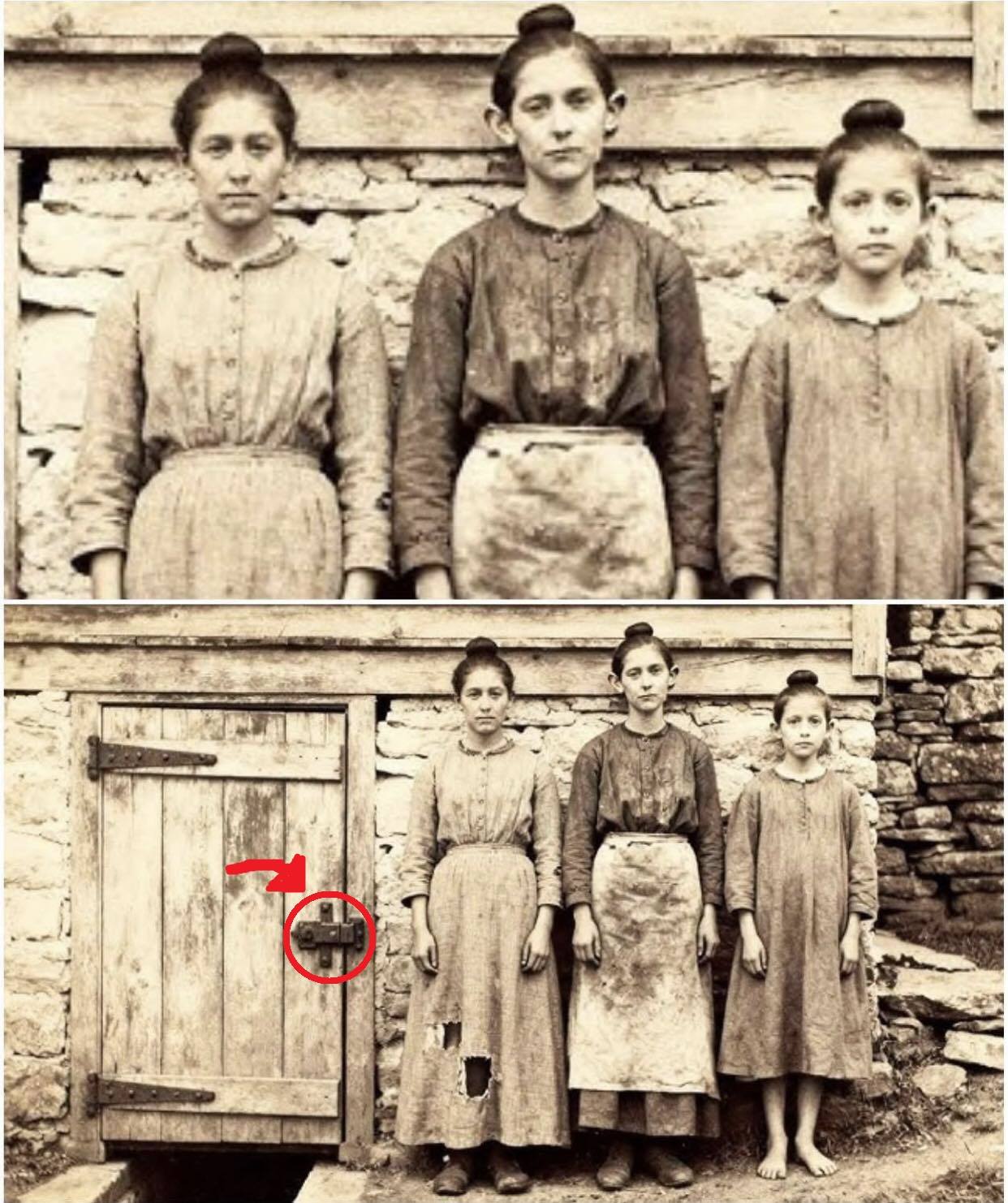
The legend of the Bird farmhouse remains a grim silhouette against the horizon of Stillwater Creek. Its windows are thick with the dust of decades, and its roof is bowed like a weary spine. In the summer of 1877, the residents of Monroe County were struck by a chilling realization: the two sisters living there, Prudence and Mercy Bird, had not spoken to another soul in nearly six years.
When the county physician finally forced entry, he encountered an atmosphere thick with the scents of smoke, oxidized iron, and long-standing illness. The sisters were the daughters of Jonas Bird, a farmer once respected for his productivity but notorious for a violent temperament. Following their mother’s passing, the girls vanished from public life, receding into the shadows of the family estate.
By 1870, rumors circulated that Jonas had lost his sight and that his daughters had become singularly devoted to his care. No funeral was ever held, but by 1877, neighbors whispered that the patriarch had long since departed this world. However, as the sheriff’s deputy stepped into the parlor, he found the floorboards blackened and warped. Coiled through a jagged hole in the floor was a heavy iron chain.
In the darkness of the cellar, they found Jonas Bird. He was alive but skeletal—a man reduced to little more than breath and bone. He attempted to cry out, but his voice failed him. For five years, he had been held in the darkness. Nearby, a tin container held Prudence’s diary. It told a harrowing story of two daughters convinced that their father’s past transgressions had corrupted the family line. They believed the only path to spiritual purification was to keep him beneath the earth until a divine sign was given.
The early entries were unsettlingly calm. One passage read: “Father asks for mercy, but mercy is a virtue we no longer possess.” What followed was a ritual of isolation. Each night, whispering scripture they barely understood, the sisters lowered a bucket of sustenance through the floor. They told him he was being “refined.”
Jonas, in his few moments of strength, warned them that they were becoming exactly what they claimed to be curing. While the community later claimed they always suspected something was wrong, the truth was that every family carried the weight of the post-war years. No one wanted to look too closely at the darkness next door.
The Return to Stillwater Creek
In the biting winter of 1878, Dr. Alton Reeves returned to the creek. Though the Bird sisters had been removed to an institution, the townspeople claimed the farmhouse was no longer silent. They spoke of voices drifting across the fields at night. Reeves, a man of science who believed that darkness could take root in a physical location, insisted on investigating.
The house sat in a state of suspended decay. Reeves knelt by the hole in the parlor floor, his lantern casting flickering shadows. The metallic scent of the cellar remained, sharp and oppressive. Descending into the darkness, he found the remnants of the elder Bird’s captivity. The iron chain that had bound Jonas was snapped clean, its end buried deep in the soil.
Hundreds of layered scratches covered the walls—marks left by many hands over a long period, rather than just the desperate clawing of one man.
“How many were kept here?” Reeves whispered.
From a corner of the cellar, he heard a heavy, dragging step. His lantern revealed a door of black iron, partially buried and secured with fresh wooden pegs. Someone had recently sealed it. As he touched the cold metal, he saw small phrases etched into the surface: Forgive us. A soft rustle came from behind the iron, followed by three slow, deliberate taps. Terrified, Reeves backed away. He looked toward the top of the stairs and saw two figures standing perfectly still, watching him. By dawn, Reeves’s horse was found at the gate, but the doctor was gone. The only evidence left behind was a shattered lamp and a torn page from Prudence’s diary: “Father said the earth would keep our secrets. But the earth never forgets.”

The Secret Tunnel
By 1879, the farmhouse was a forbidden landmark. Sheriff Thomas Kale, the man who first found Jonas, could not rest with the unanswered questions surrounding the doctor’s disappearance. He returned to the cellar at dusk.
The iron door had been torn from its hinges, revealing a narrow, hand-carved tunnel that smelled of damp earth and decay. Following the passage, Kale found a bundle of linen tied with hair. Inside was another diary, its first page bearing a frantic plea: Mercy, please forgive me.
The handwriting was Prudence’s, but the tone had shifted. It described nights when Jonas Bird stopped pleading and began whispering from the earth. Prudence wrote that Mercy had begun to listen to him—that she believed unity with their father was the only way to truly “purify” his spirit. The diary ended with a terrifying entry: “We opened the door. The doctor refused to help. He said he heard his mother’s voice, but it wasn’t her.”
Kale found a piece of cloth tucked into the back of the book, embroidered with a name: Jonas Jr. As he realized the implications, a low, synchronized chuckle echoed from deeper in the tunnel. Kale fled, leaving the diary behind, the voices of two sisters harmonizing in the dark.
The Asylum and the Final Echoes
Prudence and Mercy were confined to the Stillwater County Asylum for four years. While official records called them peaceful, the staff dreaded their presence. They spent their nights whispering to the floorboards, claiming that “He” was still in the earth.
Mercy’s condition peaked during the full moon. She would scratch at the walls until her fingernails bled, pleading to return home to “finish what was buried.” Prudence sat by the window, stitching small, infant-like figures out of rags, each marked with a crimson thread across the chest.
On June 3, 1881, a massive storm flooded the asylum’s lower levels. Guards heard Mercy screaming. They found her standing in a corner, arms outstretched, while Prudence lay motionless in a pool of water at her feet. Dr. Luther Wayne reported that as Prudence passed, two distinct voices emerged from her throat, crying for forgiveness.
When Wayne returned to retrieve Prudence’s body, it was gone. Only a trail of small, muddy footprints remained, leading into the flooded hallway. Mercy was found dead the next morning, clutching a scrap of paper that read: “He forgave us. He’s waiting for you now.”
The asylum was abandoned shortly after, as staff reported seeing pale figures wandering the flooded basement. Years later, during demolition, workers found iron chains embedded in the foundation and a nameplate belonging to the long-lost Dr. Alton Reeves.
The Unearthing
Seventeen years later, workers clearing the land for a coal company made a discovery that halted their progress. Deep in a pit, they found not a coffin, but shackles.
A young sheriff, skeptical of the local ghost stories, arrived to investigate. He found iron links curling through the soil like veins. Beneath them were the remains of two individuals. Their skulls were turned toward each other, connected by a length of wire wrapped tightly like a wedding knot.
Wedged between the remains was the missing half of Prudence Bird’s diary. Its final pages spoke of a hunger that had replaced their father—something that wore his memories like a mask.
“We thought we were burying a man,” the entry read, “but the man was already gone. Hunger is what we bound, and hunger never goes away.”
The workers refused to continue. One man vanished that night, only to be found partially buried by the creek the next morning, his mouth filled with earth. The company abandoned the site within a week.
Today, the Bird farmhouse remains a skeletal ruin. The roof has collapsed, and the cellar breathes cold air into the summer heat. Locals avoid the area, but every few years, the shifting earth reveals a piece of the past: a rusted chain, a scrap of linen, or a fragment of a page.
On those pages, the message is always the same, written in a trembling, collective hand: “He is still in the earth.”