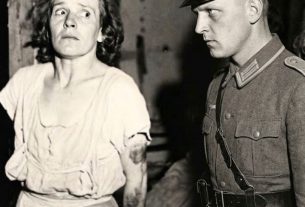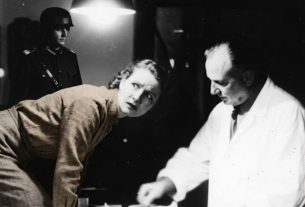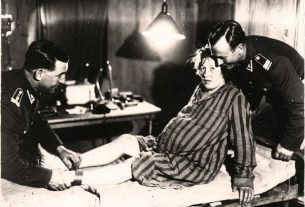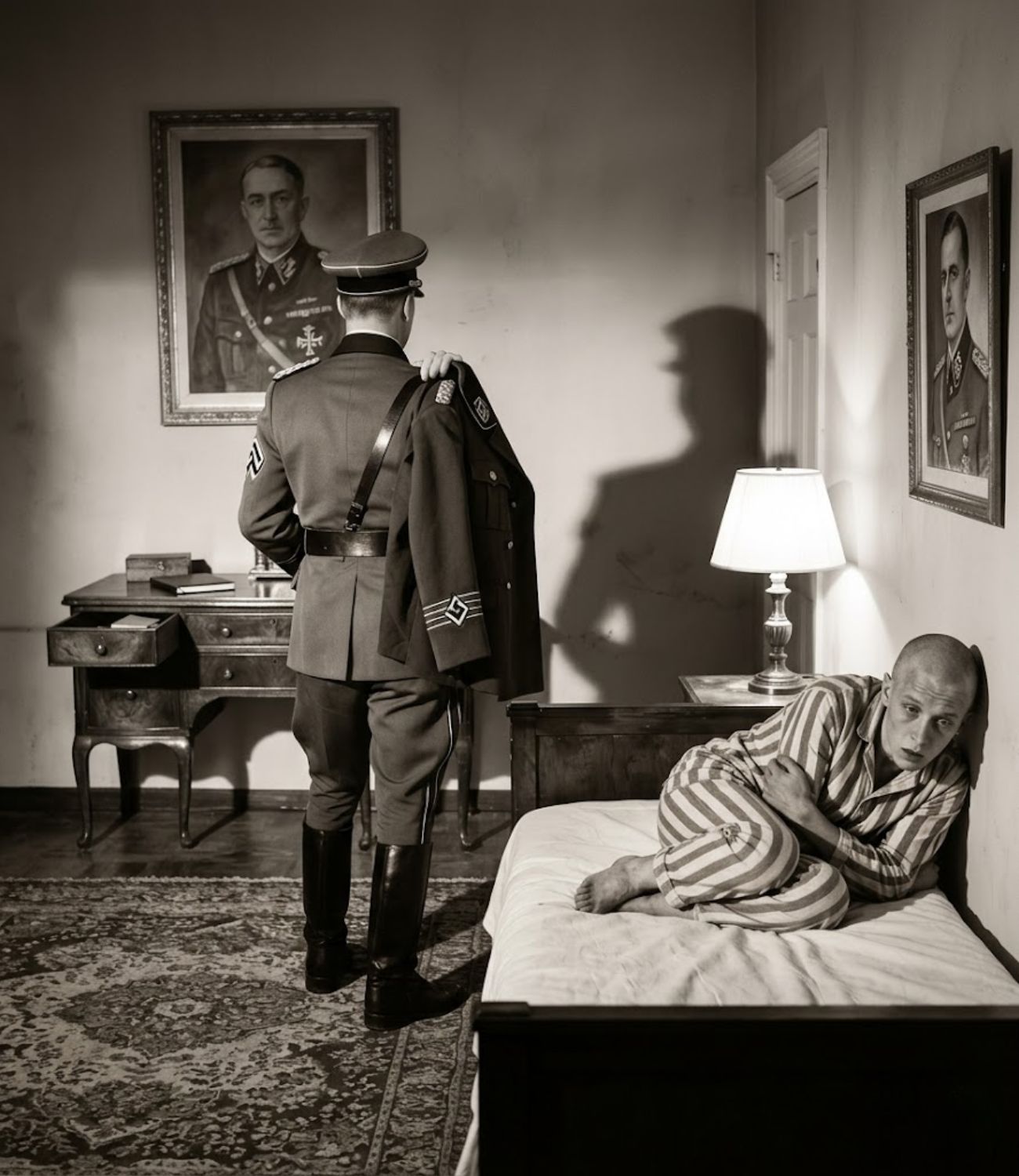
In a single moment, the world narrowed to a cold, singular clarity. The air in the office was thick with the scent of tobacco and polished leather. The officer, a man named Voss, leaned back in his chair, his eyes fixed on the prisoner standing before him.
“Everything is clear now,” Voss said, his voice smooth and devoid of malice. “This evening, you will come to my quarters. You will dine with me. We will talk.” He paused, the sentence hanging unfinished in the air. He didn’t need to complete it. The unspoken implication was a weight that filled the room. “You have a choice, of course. You can refuse.”
Auguste Garnier stood perfectly still. He knew the geography of this “choice.” If he refused, he would be sent back to the stone quarries—the killing fields where men vanished into the earth after a few weeks of grueling labor and starvation.
“And if I refuse?” Auguste asked, though he already knew the answer.
“Then you return to the quarries,” Voss replied, leaning forward. “You will die in a few weeks, like the others. Or, you can accept. You can live comfortably, eat correctly, and survive. What do you choose?”
It was a question disguised as an order, a bargain struck in the shadow of the gallows. Auguste looked at the officer, then at the floor. Survival was a primal instinct, yet the cost was his very self.
“I accept,” Auguste said.
“A wise decision,” Voss remarked.
That evening, Auguste went to the officer’s quarters. What occurred there—the specific interactions, the conversations, the profound sense of displacement—he would never describe in detail. Not to the historians decades later, nor to his closest companions. He simply survived. When the sun rose the next morning, he was still breathing. At that moment, in the hell of the camp, that was the only metric of success.
The Architecture of the System
In the days that followed, Auguste began to grasp the true scale of what was happening. He was not alone. He had been moved to Block 46, which served as a “reserve”—a pool of selected prisoners chosen for their youth, their appearance, and their presentation. Officially, these men were assigned to “special services”: cleaning officers’ quarters, performing domestic chores, and running errands.
Unofficially, the entire camp knew the truth. There were twenty-three of them in the block, men of different nationalities—French, German, Dutch, Polish. All wore the pink triangle, the mark of those persecuted for their identity. Each was “assigned” to one or several officers.
Auguste met the others who shared this Limbo:
-
Marcel Dubois (26, French): A former dancer, assigned to the deputy commander. He moved with a ghostly grace, even in his prisoner’s stripes.
-
Willem Vanerberg (31, Dutch): A former teacher. He was assigned to two different officers on a “work-study” rotation. He was the intellectual of the group, always observing.
-
Klaus Richter (24, German): A former student, assigned to the chief camp physician. He was the youngest, and the light in his eyes was already beginning to fade.
-
Stanisław Kowalski (29, Polish): A former actor. He was assigned to a rotating group of five men. He survived by treating every moment as a performance.
The rules were absolute. When an officer called, you went without question and without delay. You performed whatever was asked. You smiled, you expressed gratitude, and you returned to Block 46 until the next summons. In exchange, you were spared the death marches and the quarries. You received adequate food and a clean bed. It was the ultimate bargain: your dignity for your life.

Strategies for the Mind
On the first night they were alone together, the five men sat in the dim light of the block and spoke.
“How are you holding up?” Marcel asked Auguste.
“I leave,” Auguste replied. “I go elsewhere in my head. I go back to Lyon, to my bookstore. I imagine I am putting away books. That is all I do.”
Marcel nodded. “Me? I dance in my head. I am on a stage under the lights. I am not truly here.”
Willem had a different method, one born of a teacher’s precision. “I count,” he said. “I count everything—seconds, minutes, breaths. When I count, I don’t think. And afterward, I record the details in my mind: the date, the time, what occurred.”
Auguste looked at him, surprised. “For what purpose?”
“Because one day, someone will have to know,” Willem said firmly. “Someone will have to testify.”
Klaus, the student, said nothing. He sat with a blank look, a hollow shell of a man. “He’s going to break,” Marcel whispered. “He won’t hold on.”
“We can’t leave him alone,” Auguste insisted.
“What can we do?” Marcel asked.
“Just being here is everything,” Auguste replied.
Stanisław, the actor, had the most disturbing approach. He was playing a role every second of the day. “I am no longer Stanisław,” he explained. “I am a character who does these things. Stanisław watches from a distance. He is not involved.”
“And does it work?” Auguste asked.
“I don’t know,” Stanisław said. “But I am still here.”
The Invisible Resistance
The weeks turned into months. The system functioned with a cold, clockwork efficiency. The officers had their favorites, and the prisoners survived. An absolute silence governed the arrangement. Other prisoners in the camp looked on with a mix of suspicion and unacknowledged envy; those in Block 46 lived longer, worked less, and ate better.
One afternoon, Auguste received an unexpected visit from a prisoner from the main camp—a man wearing a red triangle, the mark of a political prisoner.
“Are you Garnier, the bookseller?” the man asked.
“Yes. Who are you?”
“Call me Henri. I need to speak with you.”
Henri knew the essentials of what happened in Block 46. “I’m not here to judge you,” he said. “I’m here to propose something. You have access to the officers’ quarters. You see documents. You hear their conversations.”
Auguste immediately understood. “You want me to spy.”
“I want you to observe, to memorize, and to transmit,” Henri said. “It is a way to make sense of the suffering.”
Auguste thought about those words for days. To make sense. What he did with Voss had no meaning; it was a transaction of survival. But if he could turn that proximity into a weapon, perhaps he could reclaim his soul. He agreed.
Auguste became a “passive” agent. He stole no documents and sabotaged no equipment. Instead, he became a master of listening. Voss loved to talk. After the meals, he would drink brandy and boast about politics, military strategy, and the gossip of the High Command. He viewed Auguste as an object—a “thing” that couldn’t possibly understand or care about the world of men.
Voss spoke of troop movements, supply problems on the Eastern Front, and the growing tensions among the leadership. Auguste asked innocent questions, acting the part of the admiring companion, while his mind acted as a steel trap, recording names, dates, and figures.
Every week, Auguste passed this information to Henri through a chain of coded messages and furtive encounters. He eventually persuaded Willem and Stanisław to join the network.
“If I do this,” Stanisław said, “I won’t be a character anymore. I will be me. Stanisław.”
“Is that a problem?” Auguste asked.
“I don’t know,” Stanisław admitted. “It has been a long time since I have been myself.”
Ultimately, he chose to become a man again, even a dangerous one. They formed an invisible chain of resistance. They were the perfect agents because, to their captors, they were invisible.
The Breaking Point
The danger was a constant shadow. One evening, Voss looked at Auguste with sudden, piercing suspicion. “You pose a lot of questions lately, Auguste.”
Auguste felt his blood freeze. “I am simply interested in your work,” he said, keeping his voice steady. “It is fascinating to hear how the world is being shaped.”
Voss stared at him for a long, agonizing moment, then laughed. “You are a flatterer. I like that.”
While Auguste navigated the danger, Klaus finally succumbed. In January 1943, he simply stopped getting up. He lay in his bed, eyes wide, staring at the ceiling in a state of total catatonia. The chief physician examined him and shrugged. “Mental collapse. He is no longer of any use.”
Klaus was transferred to the “invalid block.” He died three weeks later, officially of pneumonia. His death haunted the survivors. “It could have been any of us,” Marcel whispered.
“We have to support each other,” Auguste said. “We have to stay human. That is all we can do.”
Auguste began a second, more personal project: a list. He documented the names of the officers, the dates, the prisoners used, and the nature of the system. He wrote it in his mind first, and when he found scraps of paper, he scribbled codes and abbreviations.
“If we survive,” he told Willem, “we will have proof. If we don’t, we will hide these papers, and someone will find them.”
The Collapse of the Block
In March 1943, an SS Inspector named Werner Lang arrived at the camp. He was colder and more methodical than the others. He noticed the privileges of Block 46 immediately. “Why are these prisoners treated like guests?” he demanded of the commander.
“They are domestic servants,” the commander replied.
“Servants who eat better than the guards?” Lang countered.
An investigation began. Henri warned Auguste to stop his transmissions. “They are looking for a mole. You must make yourself forgotten.”
Auguste stopped the spying, but he continued the list. In April, the investigation uncovered something scandalous—not the resistance, but private letters written by an officer to a prisoner. The absolute hypocrisy of the High Command was exposed. Berlin was furious.
The block was dissolved. Officers were transferred or forced into “honor” suicides. Voss disappeared one night, taken by the Gestapo. Auguste never saw him again.
The survivors of Block 46 were sent back to the main camp. The “privilege” was over; they were returned to the normal hell of the quarries and the hunger. Before the move, Auguste buried his list in a tin box under a specific stone near the north latrines. “If I die,” he told Willem, “it is there.”
The Promise Kept
Auguste Garnier did not die. He survived the quarries, a bout of typhus, and the death marches of 1945. When the Americans liberated the camp on April 11, he was a skeleton, but he was alive. His first act was to return to the latrines and dig up the tin box. The papers were damp and fragile, but the ink held.
Willem and Marcel did not survive the final months. Stanisław survived and returned to Warsaw. Auguste returned to his life, but he kept the list in a drawer for forty years. No one wanted to hear about the pink triangles or the “special blocks.” The silence of the camp was replaced by the silence of society.
In 1983, a young historian named Thomas Müller knocked on Auguste’s door. He was a doctoral student specializing in the persecution of those deemed “social outsiders” by the regime.
“Nobody wants to talk to me, Mr. Garnier,” Thomas said. “But someone has to do it for history.”
Auguste looked at the young man and realized his long wait was over. He pulled out the yellowed, fragile pages. “I promised the dead that someone would know,” Auguste said. “I am holding my promise.”
The interview lasted three days. Auguste spoke the names out loud for the first time: Klaus, Marcel, Willem, Stanisław. He described the bargain, the resistance, and the price of survival.
“Why now?” Thomas asked.
“Because I am going to die soon,” Auguste said. “I don’t want to take this with me. I regret that I couldn’t save them all. But if I had died then, the story would be lost.”
The Legacy of the List
Thomas published his book, The Forgotten Ones, in 1987. It caused a scandal and a profound reckoning across Europe. The truth was finally in the light.
Auguste died in February 1991. His funeral was small, attended by Thomas and a frail Stanisław. Afterward, a stranger approached the historian. “My name is Pierre Moreau,” the man said. “My father was a prisoner in the quarries. In 1942, he was suddenly removed from a transfer list to a death camp. He never knew why.”
Thomas looked at the man and smiled. “Auguste,” he whispered.
Auguste had used his influence with Voss to save others, transmitting names to the resistance to have them moved to safer details. He had created life in the midst of death.
Auguste’s list is now held in the national archives. It is a document of a crime, but more importantly, it is proof of human agency. It proves that even in absolute horror, men find a way to stay human. They observe, they remember, and they transmit.
Auguste Garnier lived long enough to tell five destinies. None were perfect, none were heroic in the classical sense, but all were human. And perhaps that is the truest resistance of all: to refuse to be erased.