The Architecture of Injustice
Interrogation rooms within Gestapo headquarters followed a disturbing uniformity. Whether at the Klapperfeld Police Prison in Frankfurt or the local headquarters in Lyon, these spaces were designed for total psychological and physical domination.
The sessions often followed a calculated progression. Interrogators would begin with verbal abuse and threats, escalating into severe physical force. In Lyon, 13-year-old Simone Lagrange recalled the chilling contrast of Klaus Barbie entering the room holding a cat. She initially felt a sense of relief, believing that a man who showed affection to an animal could not be truly cruel. However, that illusion was shattered within moments when he used physical force to demand information about her younger siblings.
The Methodology of Control
The “enhanced interrogation” techniques employed by the Gestapo were often categorized under the term Verschärfte Vernehmung. This was a systematic approach to breaking resistance through a combination of physical stress and psychological warfare.
Freezing Interrogations: The Water Methods
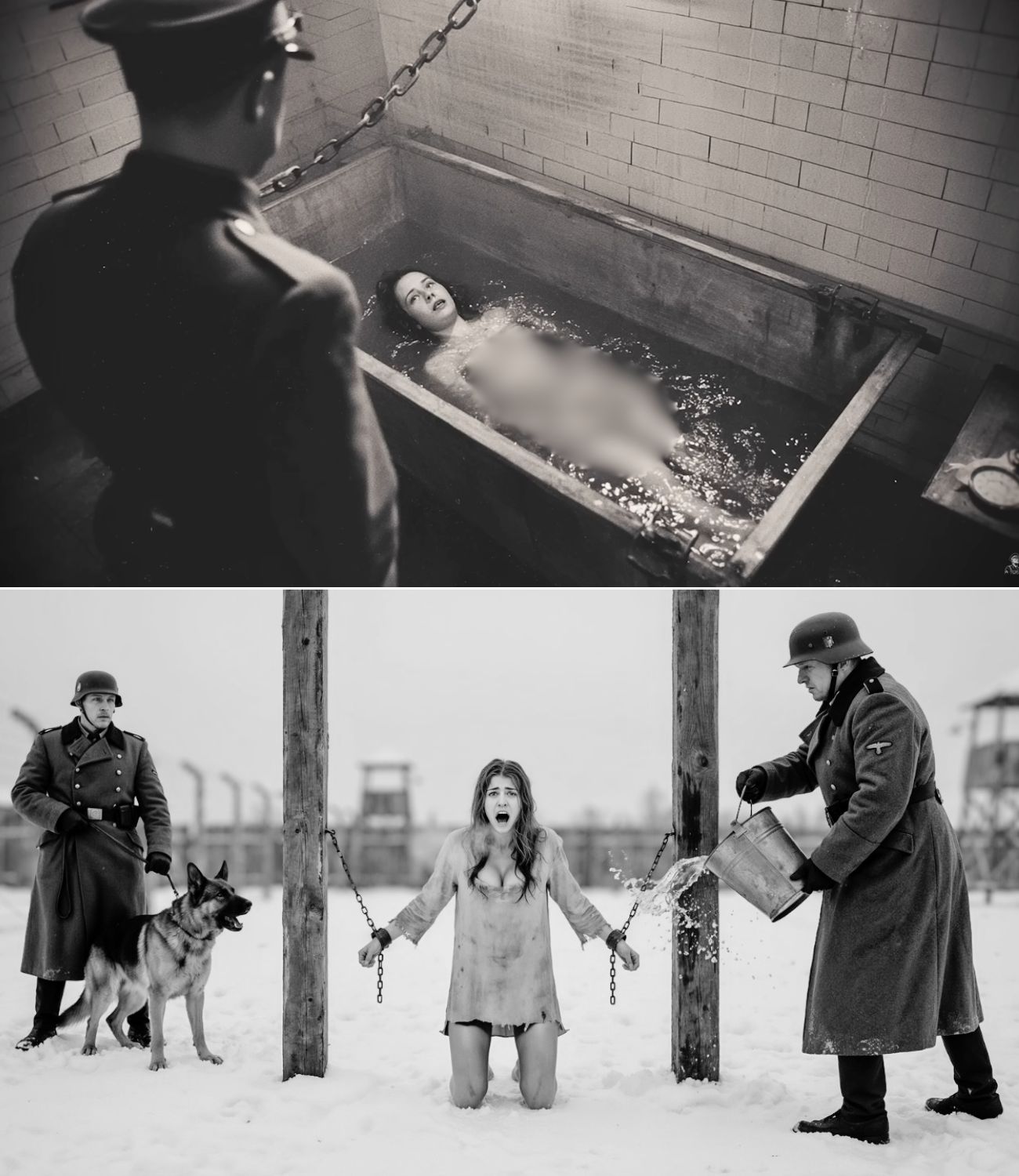
One of the most feared techniques in France was known as la baignoire. This involved the repeated immersion of prisoners in ice-cold water.
Lisa Lesèvre, a member of the French Resistance, endured this treatment for nine days in 1944. She was restrained and forced into a tub of freezing water, where interrogators would hold her head beneath the surface until she reached the point of collapse. Each time she surfaced, the process would begin again.
This method was favored by the Gestapo because it:
-
Left no permanent visible marks on the skin.
-
Induced hypothermia and shock, making the prisoner more vulnerable to questioning.
-
Created a sense of total helplessness, simulating the sensation of drowning without the release of death.
Even pregnant prisoners, such as Henriette Bie Lorentzen in Norway, were not spared from this calculated cruelty, often being subjected to high-stress interrogations before being transferred to concentration camps.

Sleep Deprivation and Isolation
Sleep deprivation was a cornerstone of Gestapo tactics. By keeping prisoners awake for days through continuous questioning, bright lights, and physical discomfort, interrogators aimed to erode the prisoner’s ability to maintain a coherent narrative.
The Impact of Solitary Confinement
Isolation amplified the effects of exhaustion. Prisoners were kept in cells only a few square meters in size, cut off from all human contact. The silence itself became a form of torture, occasionally broken by the sounds of other prisoners being moved.
To heighten the psychological pressure, guards would deliberately transport victims past the cells of others, showing them the physical state of those who had already been interrogated. This constant state of terror was intended to break a prisoner’s resolve before they even entered the interrogation room.
The Standing Cell: Endurance Without End
Among the most insidious methods was the standing cell. In these small, upright chambers, prisoners were forced to stand for hours or even days at a time.
In Poland and Germany, women were often placed in these cells in “stress positions,” sometimes with their hands bound high above their heads—a position known as “the pillar.” This exploited the body’s natural limitations, causing:
-
Severe swelling in the lower limbs.
-
Excruciating muscle cramps.
-
Circulatory failure and fainting.
Interrogators used this method because it pushed the body to its absolute capacity for pain without the use of specialized equipment or leaving immediate outward wounds.
The Rise of “Clean” Torture
As the occupation progressed, the Gestapo increasingly adopted “clean” torture techniques—methods designed to inflict maximum pain while leaving minimal evidence that could be used in future legal proceedings.
Electrical Interrogations
Interrogators utilized hand-cranked generators, often repurposed telephone magnetos, to deliver electrical shocks. By applying electrodes to sensitive areas, they could induce muscle spasms and intense pain. Unlike physical beatings, which left obvious bruises, electrical methods left only small marks that faded over time.
Alice Lejeune, arrested in 1944, suffered injuries so severe during these sessions that she eventually lost her sight. Her testimony, along with others, highlighted a comprehensive system of pain designed for total compliance.
The Legacy of the Survivors
The women who survived these rooms carried the scars for the rest of their lives. Many lived with permanent spinal injuries, vision loss, or the deep psychological trauma of their experience.
In 1987, decades after the war, survivors returned to Lyon to testify against Klaus Barbie. Their presence in the courtroom was a testament to the failure of the Gestapo’s ultimate goal: though the regime sought to destroy their spirits, it was their voices that eventually spoke the truth of what happened within those walls.
Their accounts serve as a vital reminder of the strength required to endure oppression and the importance of ensuring that such systematic cruelty is never erased from history.
Based on these accounts, does the transition from physical force to more “psychological” and “clean” methods change how you view the evolution of state-sponsored interrogation?