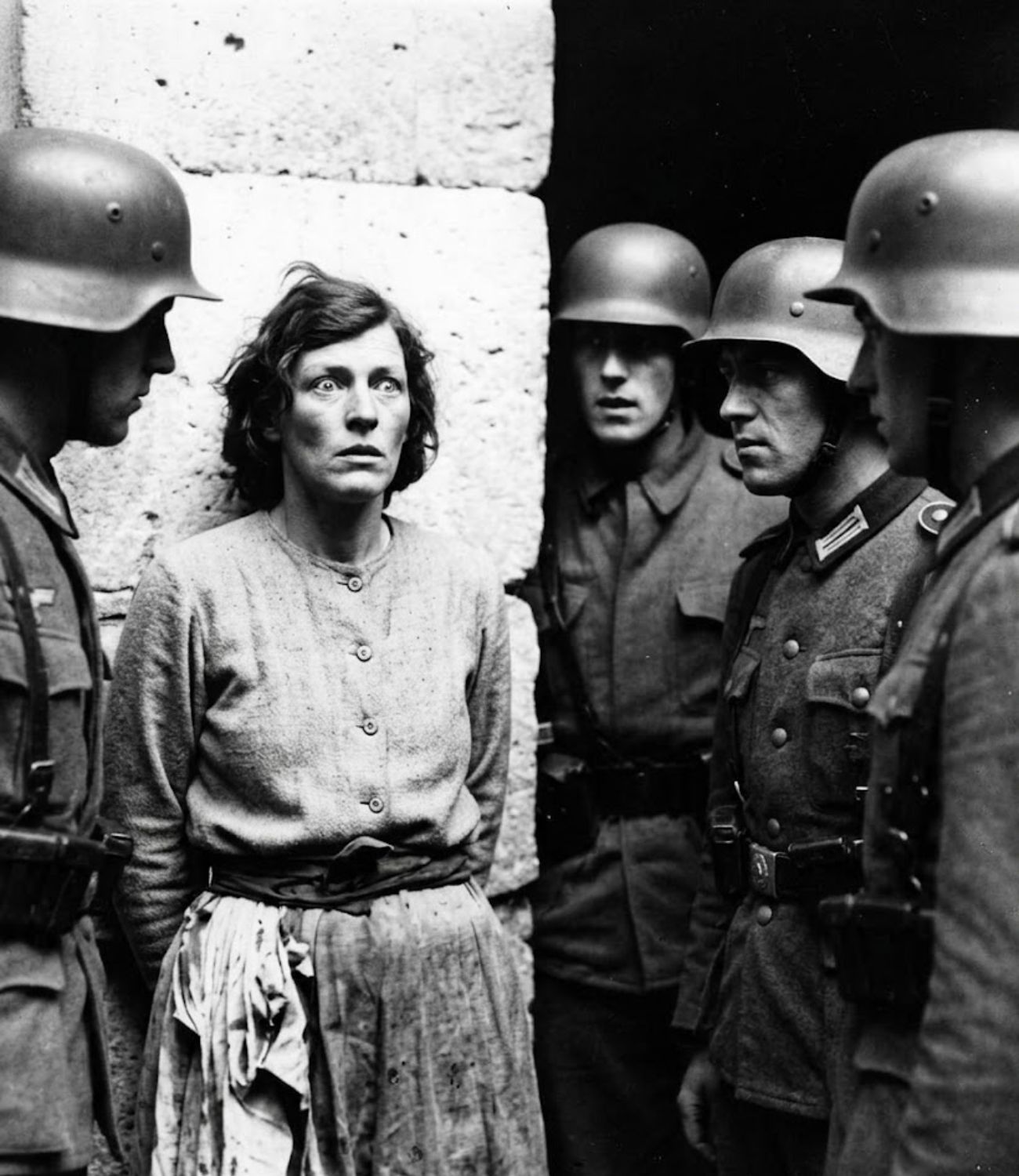
Act 1: The Descent into the Shadow
Lucienne’s journey into the unknown began on a freezing morning, March 12, 1944, in Reims. Following an anonymous report, soldiers arrived at her home, taking her away in view of her neighbors. She was transported to a former convent near Dijon, which had been repurposed into a high-security detention facility.
Upon arrival, she was met by an officer named Klaus Reiter. He was a man of unsettling composure; he never raised his voice, believing that a quiet, methodical approach was more effective for maintaining total control. Lucienne and ten other women were immediately subjected to a process designed to strip away their dignity. They were forced to stand under harsh, industrial lights while soldiers evaluated them with the detachment one might use for livestock.
Lucienne later wrote in her notebook:
“It was not the exposure that broke me; it was the realization that, to them, we had ceased to be people. We were merely objects to be categorized.”
Adding to this ordeal, a physician identified as Dr. Friedrich Vogel conducted invasive “inspections” that lacked any medical necessity or professional ethics. These procedures were documented by soldiers as if they were scientific data. A nineteen-year-old prisoner named Marguerite collapsed during this process and was taken to a dark cell; she was never heard from again.
While military records later classified these actions as “security procedures,” they were, in truth, the first act of a systematic plan to dehumanize the prisoners and destroy their sense of self.
Act 2: The Architecture of Fear
By April 1944, the thick stone walls of the convent served as a barrier against the outside world. The women were moved to the basement, a narrow corridor of individual cells measuring less than two meters wide. There were no beds—only damp straw—and the constant cold caused the prisoners to shake throughout the night.
In this space, a new form of solitude emerged. Although they could hear the breathing of others through the thin stone walls, every woman was trapped in her own cage of fear. They were provided with meager rations: a piece of hard bread and a bowl of thin, murky soup.
The true torment began each night around 10:00 PM. Reiter would descend the stone staircase, his heavy boots creating a rhythmic, menacing sound. He would walk the length of the corridor, stopping at a door to select a woman with a silent gesture. She would be taken to a former wine depot converted into an interrogation room.
The treatment varied from physical assault to psychological games, but it always ended with a chilling warning:
“You will remain silent. If you cry out or tell the others, they will face the consequences.”
Solidarity was thus transformed into a weapon of torture. Women returned to their cells bleeding and trembling, yet remained silent to protect their companions. A librarian named Claire once passed Lucienne’s cell with her face severely bruised, unable to open one eye. She said nothing, but her gaze conveyed a depth of suffering that words could not describe.

Act 3: The Falsification of Hope
As May 1944 arrived, the sound of distant bombings suggested that the war was entering a new phase. Inside the convent, however, time felt frozen. On a bright morning, the prisoners were gathered in the courtyard—the first time many had seen sunlight in weeks.
Reiter, accompanied by a younger officer named Heinrich Müller, made an unexpected announcement: the women were to write letters to their families. For many, hope surged. They believed they might finally let their loved ones know they were still alive.
The Manufactured Betrayal
Each woman was given paper and a pen, but the content of the letters was strictly dictated. They were forced to write that they were being treated well and would be home soon. Any deviation was strictly forbidden. Lucienne wrote her letter with a heavy heart, sensing a trap.
Days later, her fears were confirmed. She heard the sound of paper being destroyed in the offices above. The letters were never sent. Instead, the facility used the information gathered to craft forged responses.
-
Geneviève was shown a letter allegedly from her mother, disowning her as a traitor.
-
Pauline received a notice stating her husband had moved on and wanted nothing more to do with her.
-
Véronique, a violinist, fell into a state of total despair after reading a forged letter from her daughter expressing hatred for her. She died three days later.
The psychological impact was devastating. The goal was to make the women believe they had been abandoned by the world, leaving them with no reason to resist.
The Resistance of the Mind
Despite the pain, Lucienne’s analytical mind remained sharp. She examined the “letter” from her mother and noticed subtle inconsistencies. Her mother always signed with a specific phrase, but the forgery used a generic closing. Furthermore, the letter mentioned a move to a new house—something Lucienne knew her mother would never do.
She began to whisper her findings through the walls:
“The letters are false. Our families have not abandoned us. Do not let them take your hope.”
Slowly, the women began to deconstruct the lies. They found spelling errors that their educated parents would never make and noticed differences in handwriting pressure. This collective discovery reignited their will to survive.
Act 4: The Judgment of Darkness
By early June, the nervousness of the guards reached a peak. On the night of June 3, the women were taken to the deepest part of the basement—a vaulted room filled with stagnant water and the smell of decay.
Reiter accused them of a conspiracy. He forced them onto their knees in the icy water and began a “Judgment of Darkness.” Moving with a single lantern, he would illuminate one face at a time and ask, “Are you lying to me?” Regardless of the answer, the prisoner was struck with the metallic lantern and subjected to a methodical beating by soldiers with batons.
When Reiter finally reached Lucienne, she chose to defy him. She looked directly into his eyes and said:
“You can take my life, but you cannot make me a liar.”
The room went silent. Reiter did not strike her. Instead, he whispered, “I do not need you to lie; I need you to disappear.” He ordered her into total isolation.
Total Isolation
Lucienne was thrown into a tiny stone box at the lowest level of the facility. It was less than 1.5 meters wide, with no light and no ventilation. She spent days—or perhaps weeks—in absolute darkness, losing all track of time. She had no food or water. In her desperation, she tried to gather moisture from the damp walls, but the thirst and hunger led to intense hallucinations.
Even in this darkness, she maintained a mental record of everything she had seen. She knew that if she survived, she would have to be the witness for all those who could no longer speak.
Does learning about these specific psychological tactics—such as the forged letters—change how you perceive the nature of resistance in historical accounts?