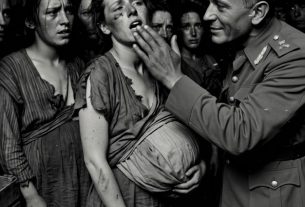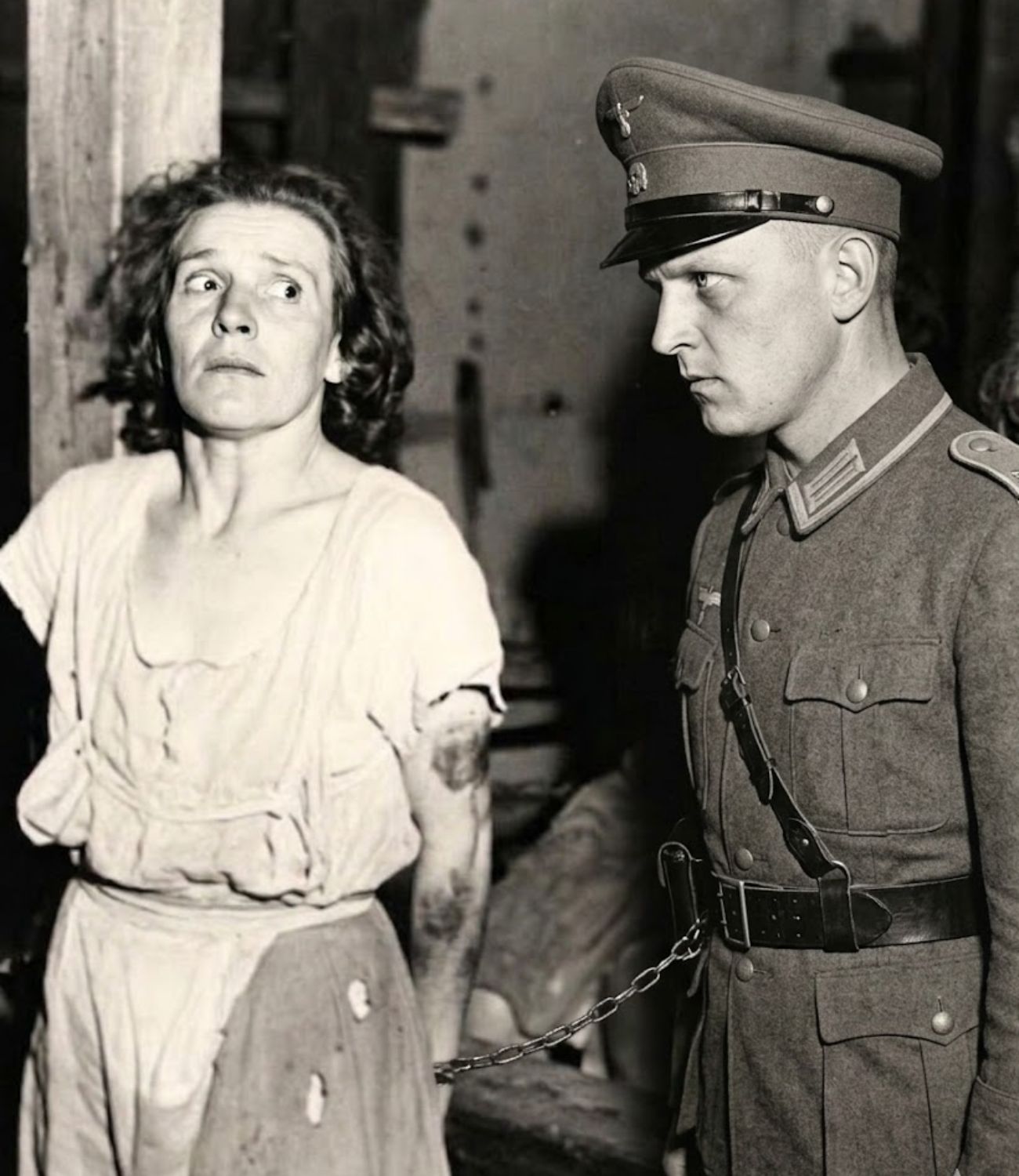
The silence in the barracks was heavy, a physical weight that pressed against the lungs of the six remaining women. One of the prisoners, an older woman named Marguerite, dared to ask in a trembling voice, “How long?”
“Forty-eight hours,” Sergeant Becker replied.
He smiled, and it wasn’t a cruel expression; it was something far more chilling. It was a technical, bureaucratic smile, the look of a mechanic explaining the specifications of a machine to ensure it reached its final goal.
Without another word, the guards began to fasten the women into heavy iron restraints. Elise felt the icy metal bite into her wrists, her waist, and her ankles. The apparatus was designed with scientific precision to keep the prisoners in an agonizing, impossible position—neither standing nor sitting. They were simply suspended, their muscles in constant, screaming tension, forced to choose between the searing pain in their arms or the cramping agony in their legs.
The heavy iron door slammed shut. The sound resonated like a gunshot through the small space. For the first time in months, Elise Duret—who had survived brutal interrogations, who had watched her own sister fall, and who had sworn never to break—felt a sensation she thought she had buried: absolute, paralyzing fear.
January 25, 1943 – 2:20 PM
Elise drifted back into consciousness, unsure if she had slept or simply blacked out. Her arms were entirely numb; her legs shook uncontrollably. To her left, Marguerite was breathing in shallow, ragged gasps, her face the color of grey wax. Across the room, a young woman named Simone was weeping, though her eyes remained dry—her body was too dehydrated to produce actual tears.
The door groaned open. Three guards entered, one carrying a metal tray containing dry bread and a single glass of water. He placed it in the center of the floor, deliberately out of reach of any of the women.
“Anyone who wants to eat,” he said in a thick Bavarian accent, “will have to ask politely. Or,” he added with a smirk, “you will wait until tomorrow.”
Marguerite, the eldest and most fragile, gave in first. Her voice was a mere shadow of a sound. “Please… water.”
The guard approached, held the glass to her lips for two small sips, and then—with agonizing deliberation—poured the remaining water onto the concrete floor.
“Anyone else want to ask politely?”
Elise gritted her teeth until her jaw ached. She would not give them the satisfaction. But even as her mind resisted, her stomach churned with hunger and her throat burned as if she had swallowed hot sand. She realized with growing horror that this was the true purpose of the 48-hour “final goal”: to transform strong, resilient women into beggars and to trade their dignity for a drop of water.

The Science of Suffering
By 10:10 PM, the first twenty-four hours were behind them. Elise understood now that this wasn’t an execution. An execution would be a mercy; it would be a liberation. This was something else entirely.
During the night, the guards returned with tools: hammers, pliers, and iron bars. They didn’t strike the women; they worked on the restraints. They adjusted the angles, tightened the bolts, and created new pressure points on the joints. There was no random brutality here; there was only a cold, calculated method.
One of the guards, an older man with greying hair, spoke with a tone that was disturbingly paternal. “You are here because you chose to be dangerous,” he said, tightening a bolt on Simone’s wrist until she groaned. “You chose to help the enemies of the Reich. Now, you will be examples of what happens when people forget their place.”
The Breaking Point
As the final hours approached on January 26, the barracks fell into a deathly silence. Marguerite had stopped breathing hours earlier. No one noticed immediately; it wasn’t until the morning inspection that a guard checked her pulse and made a clinical note on a clipboard.
“Cardiac collapse due to extreme stress,” he muttered. He looked at the survivors. “Seven hours to go. Let’s see who makes it.”
In that moment, something broke inside Elise. It wasn’t her will, but her belief that there was any rational meaning to this cruelty. They weren’t seeking information or guarding a border; they were destroying human souls for the sake of power.
Then, a small miracle occurred. The chain holding Elise’s left wrist, corroded by rust and the sweat of countless prisoners before her, snapped. It didn’t free her entirely, but it gave her hand a range of motion. She watched the guards leave, knowing she had perhaps fifteen minutes before the next patrol. Ignoring the white-hot pain in her shoulder, she reached for the waist hook.
The chain fell. Simone’s eyes went wide. “Elise, what are you doing?”
“I am surviving,” Elise whispered.
She did not know then that her escape would eventually become one of the most devastating testimonies of the war, used in international trials to prove the existence of psychological torture centers. At that moment, she was only thinking about the next few inches of concrete.
The Confrontation
By noon, Elise was physically free of the chains but still trapped within the windowless iron box of the barracks. She dragged herself to Simone, touching her face. “Stay awake, Simone. If you give up, they win.”
The door creaked open again. Sergeant Becker entered alone. He stopped dead when he saw Elise standing free in the center of the room. His eyes widened, not with rage, but with a strange, clinical admiration.
“Forty-three hours,” he mused, “and you are still fighting.”
“You know this is all going to end,” Elise said, her voice clear and resonant. “The war, your Reich—it will all fall. And then you will have to answer for this.”
Becker laughed—a dry, joyless sound. “And who will accuse us? Dead women don’t testify.”
“I will,” Elise replied, stepping forward.
Becker studied her for a long time, weighing her defiance against his orders. He slapped her—not out of anger, but as a calculated reminder of the current hierarchy—and ordered the guards to restrain her again with reinforced steel.
The Sound of the End
By 6:45 PM on January 26, Elise was back in the chains, but the atmosphere had shifted. She noticed the guards were nervous. They spoke in hurried whispers and cast furtive glances toward the door.
Then, Simone heard it. A deep, rhythmic thudding that vibrated through the floorboards. “Elise, listen,” she whispered.
It was heavy artillery. The front line was moving.
On the morning of January 27, the explosions were so close that dust rained from the ceiling. Becker ran into the barracks, his face pale and slick with sweat. “We have orders to evacuate,” he told his men. “All annexes must be destroyed. No witnesses.”
Elise felt her blood turn to ice. “Kill us now, then,” she challenged. “But every face you see here will haunt you until your last breath.”
Becker stared at her. An internal struggle played out across his features. Suddenly, he turned to his men. “Get out! Now! I will finish this.”
Confused, the soldiers retreated. Becker was left alone with the women. He walked to Elise and reached into his pocket for a key. His hands were shaking. “I am not a monster,” he whispered, perhaps to himself. “I am a soldier. Soldiers follow orders. That is how we survive.”
He unlocked her chains. Clang. The sound of the falling iron was the most beautiful music Elise had ever heard.
“You have five minutes,” Becker said, refusing to meet her eyes. “There is a supply truck 200 meters down the road. If you are lucky, you can hide in the back. I am doing this… because I have a sister your age.”
He turned and vanished into the corridor, slamming the door but leaving it unlocked.
The Escape
Elise didn’t waste a second. She dragged Simone from her restraints and then turned to Hélène, a thirty-year-old prisoner who still had some strength. Together, they worked feverishly to free the others.
But the reality was brutal. The young blonde girl and one other woman were in a deep coma, their bodies completely spent.
“We can’t carry them,” Hélène said, her voice flat with pragmatic despair. “We won’t make the truck if we try.”
Elise looked at the unconscious women. Her heart broke. Leaving them felt like becoming the very monsters they were fleeing—calculating the value of a life in seconds and percentages. She knelt by the young girl and whispered, “Forgive me.” Then, she stood and ran toward the door, knowing that if she looked back, she would never leave.
The dawn was brutally cold, the air biting at their skin like razors. They stumbled through the snow, their atrophied muscles screaming. One woman fell in the snow and did not get up; Hélène pulled Elise away before she could stop.
They reached the road and saw the truck. Two soldiers were smoking nearby. Using the mist and the darkness as a veil, the three women crawled toward the vehicle. A soldier turned—he heard a breath, a rustle. He raised his rifle.
“Go!” Elise hissed.
They bolted for the back of the truck. Gunshots shattered the quiet, the air whistling past Elise’s ear. They scrambled over the tailgate just as the engine roared to life. By some miracle, the driver had been ordered to move at that exact moment. As the truck pulled away into the grey fog, the voices of the guards faded. They had escaped the impossible.
The Witness
April 14, 1945. A provisional military tribunal in Paris.
The war was over. Germany had surrendered. In a hall once used for grand balls, former officers now sat on wooden benches. Among them was Friedrich Becker.
Elise Duret sat in the front row. Her hair had grown back, and her hands were steady. When the judge called her name, she walked to the lectern with a dignity that commanded the room. She swore her oath and began to speak.
She described the chains. She described the 48 hours. She told the court about the women who died and the women she had to leave behind. And then, she told them about Becker’s decision to let them live—a choice that defied all military logic and systematic dehumanization.
When she finished, the room was so silent that the ticking of the wall clock sounded like a hammer. The judge, a man who had seen the worst of the war, took off his glasses and rubbed his eyes.
“Does the accused have anything to say?” the judge asked.
Becker stood up. The sound of his own chains echoed through the hall. He looked at Elise—not with the technical smile of a bureaucrat, but with the hollow gaze of a man who finally understood the weight of the machine he had served.
Elise Duret had transformed her trauma into a weapon of truth. The barracks at Thionville would no longer be a secret. Because she chose to live, and because she chose to speak, the world would never be allowed to forget.
Did this account of Elise Duret’s resilience help you understand the historical significance of witness testimony in post-war justice?